Menu

The National Portrait Gallery acknowledges the Traditional Custodians of Country throughout Australia and recognises the continuing connection to lands, waters and communities. We pay our respect to Aboriginal and Torres Strait Islander cultures and to Elders both past and present.

Aboriginal and Torres Strait Islander viewers are warned that this website contains images of deceased persons.

Together on Country

by Dr Emma Kindred, 2 July 2025

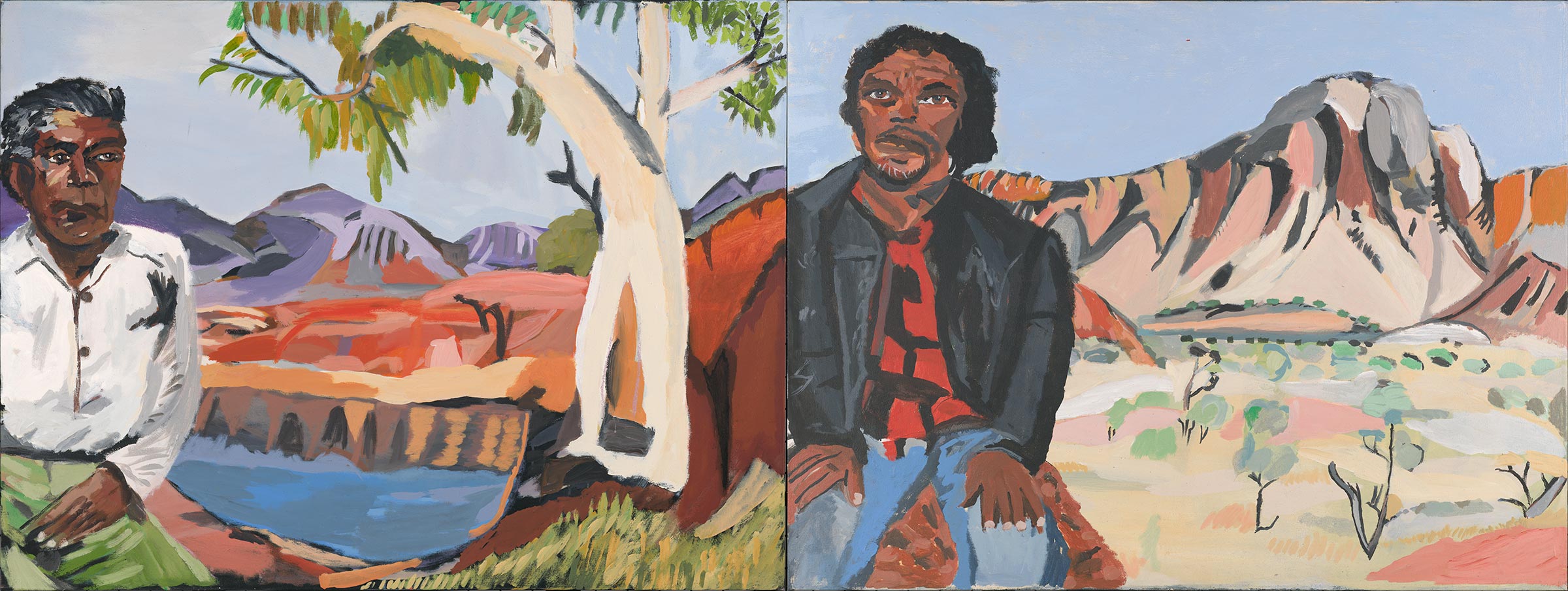
Albert and Vincent, 2024 Vincent Namatjira OAM. © Vincent Namatjira/Copyright Agency, 2024

In Vincent Namatjira’s Albert and Vincent (2024), two artists converge in time and space to tell a story of legacy set against the complex histories of colonisation in Australia. The Western Aranda artist painted himself and his great-grandfather, celebrated Western Arrernte/Aranda/Arrarnta artist Albert Namatjira, before the brilliant colours and ancient rock formations of their Country near Ntaria/Hermannsburg in the Northern Territory. The collapsing of chronologies that allows the artists to sit side-by-side as an echo, a doubling, is a disruptive methodology, synchronous with the First Nations concept of the Everywhen: the co-existence of past, present and future.

‘Albert Namatjira’s legacy lives on in the power of his art and in the work of his descendants,’ Vincent wrote in his 2023 book Vincent Namatjira: Australia in colour. ‘The old man was a teacher, passing on his talents and ideas to his family. When I research Albert Namatjira’s life, when I look at his work and when I paint our Country myself, I can feel him teaching me too and I feel at peace.’

Vincent was born in Mparntwe/Alice Springs but grew up in foster care with his sister in Boorloo/Perth. He returned to Ntaria/Hermannsburg at 18, reconnecting with family, language, culture and Country. For over 10 years he has painted from Iwantja Arts in Indulkana, on Aṉangu Pitjantjatjara Yankunytjatjara (APY) Lands, South Australia. The dynamic art centre is home to fellow artists including Betty Muffler, Kaylene Whiskey and Tiger Yaltangki, and it is here that Vincent met his father-in-law, Yankunytjatjara figurative painter Kunmanara (Jimmy) Pompey, who was an important influence on the young artist. In 2020, Vincent became the first Aboriginal artist to win the Archibald Prize in its then-99-year history with his portrait of former AFL player Adam Goodes. He is one of only 32 First Nations artists who have exhibited in the prize, the first of whom was Robert Campbell Jnr in 1989.
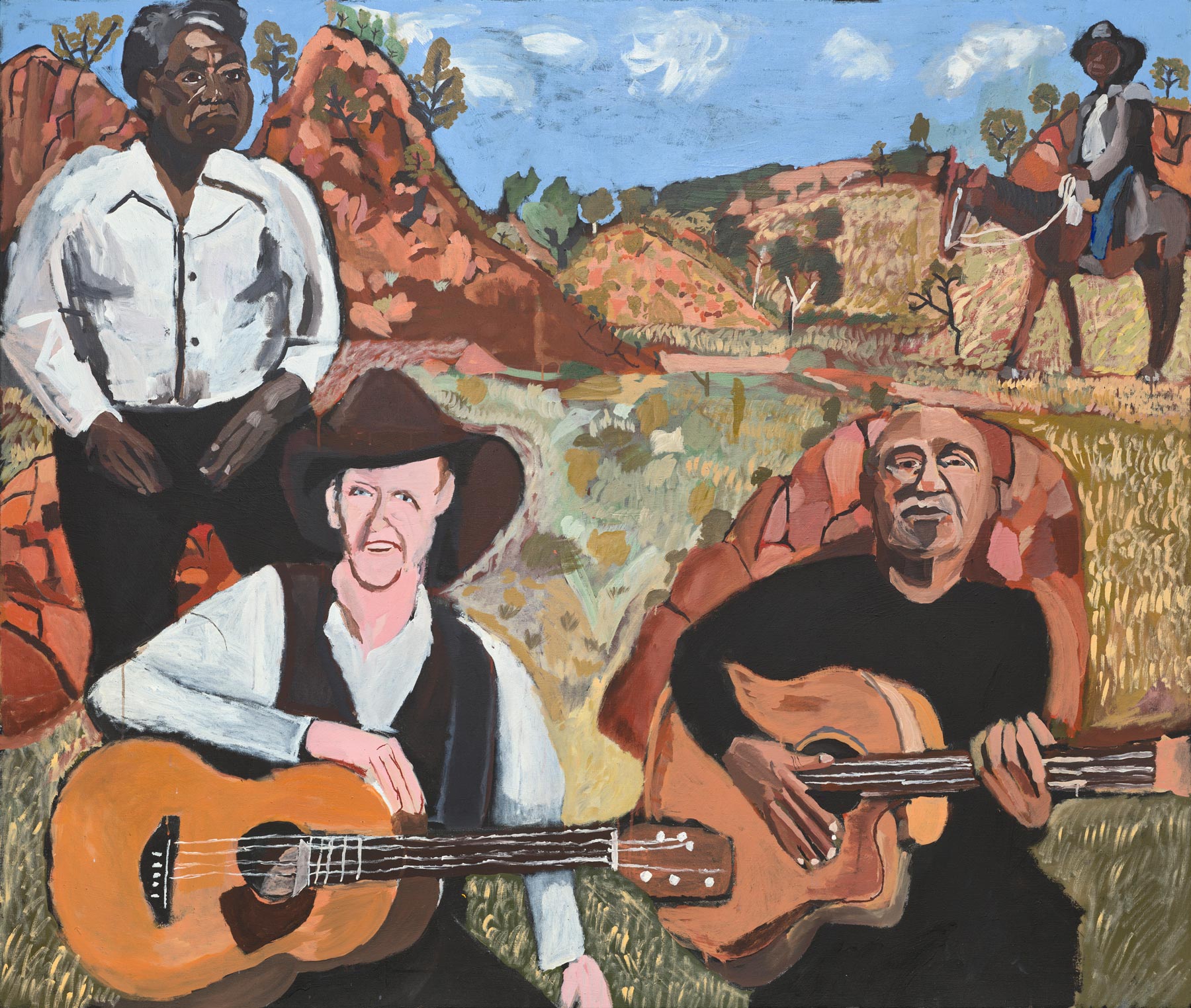
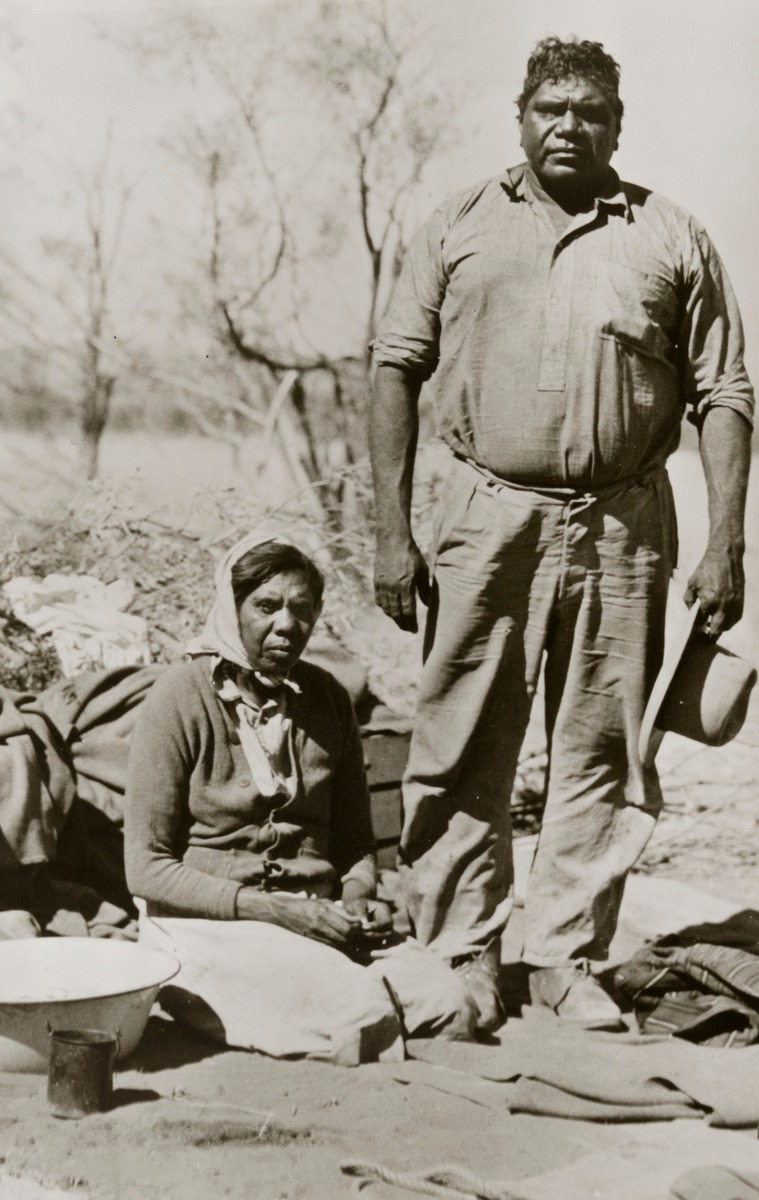
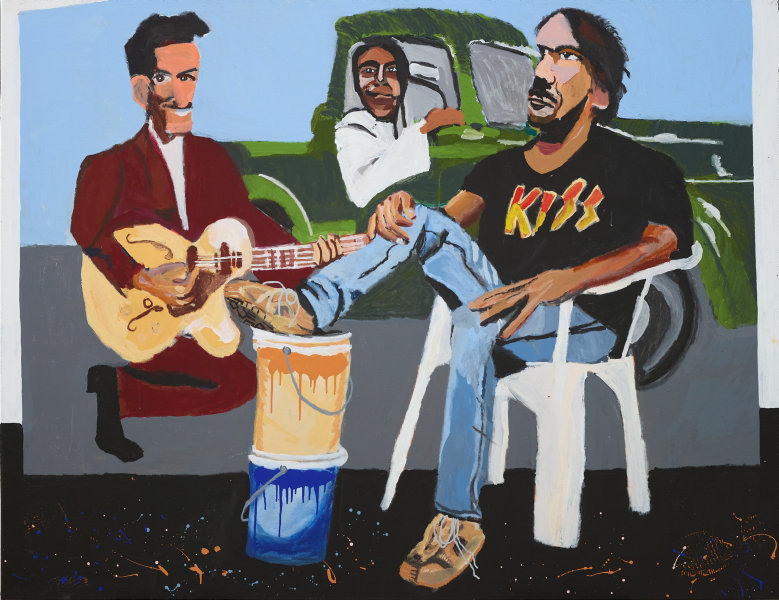
The persona of Albert has been an enduring focus for Vincent, and a subject he has repeatedly returned to in his portraiture over the last decade. Albert appears in various guises in Vincent’s work: with paintbrush in hand standing next to the artist and art teacher Rex Battarbee; driving his ute with Vincent and Chuck Berry; meeting Queen Elizabeth II and Prince Philip; and sitting with musicians Slim Dusty and Archie Roach. Incorporating Country in his paintings, Vincent directly references his great-grandfather’s watercolours, and on occasion has taken his large canvases out into the landscape, painting in the open air. True to the vibrant colours of the land, both artists employ a broad, high-key palette of purples, reds and brilliant oranges.

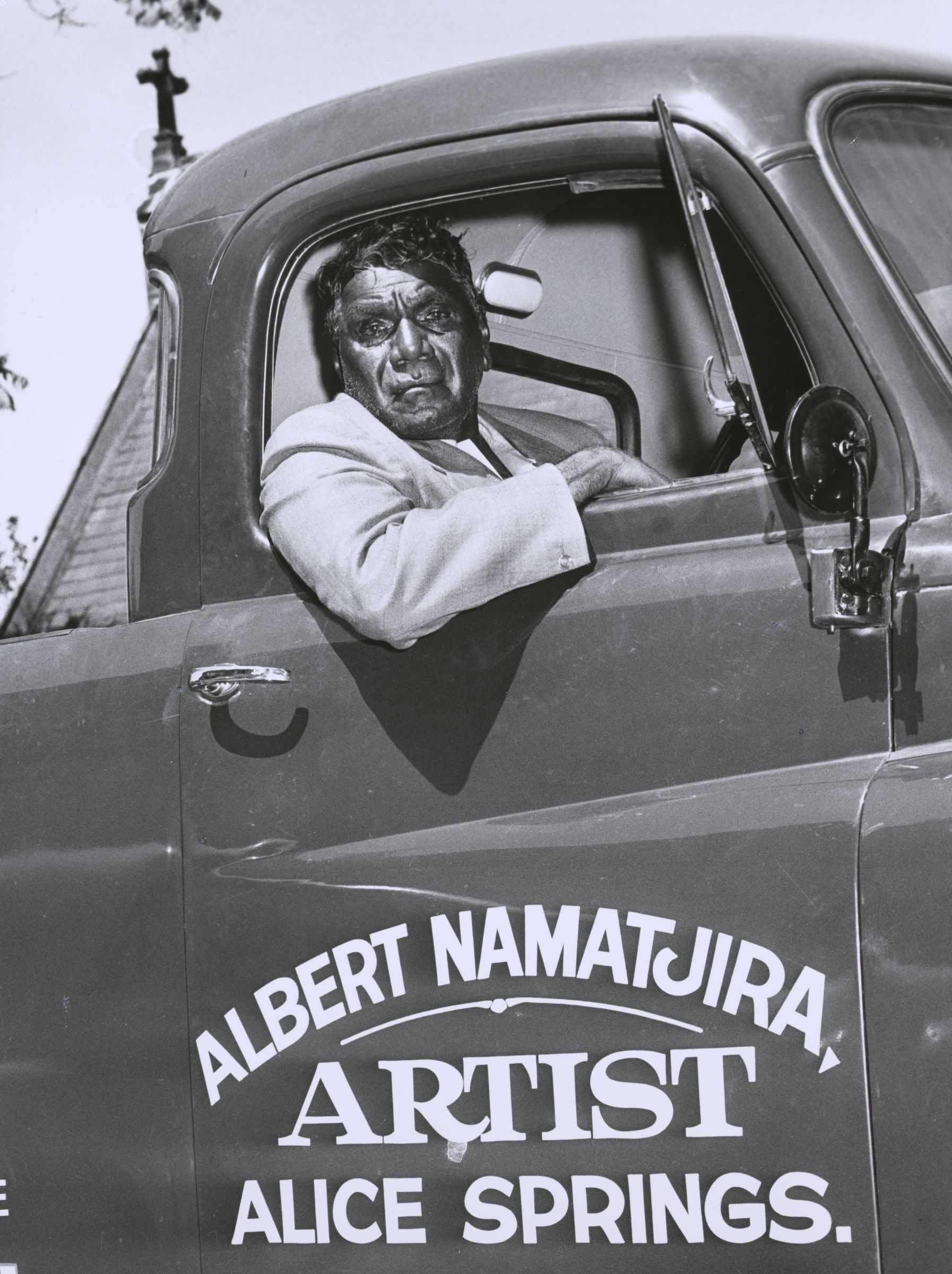
1 Albert and his wife Rubina, Macdonnell Ranges, 1946 Axel Poignant. 2 Albert Namatjira, Artist, Alice Springs, c. 1957 Ern McQuillan OAM. © Michael McQuillan's Classic Photographs.

Albert’s distinctive style, though often reductively perceived as consistent with a traditional Western landscape aesthetic, was rooted in deep Ancestral connection and knowledge of the lands spanning his father’s Country around Tjoritja/MacDonnell Ranges and his mother’s Country in the region of Mpulungkinya/Palm Valley in Central Australia. Born at the Lutheran mission in Ntaria/Hermannsburg, Albert had been making art for much of his life before establishing his practice in watercolour painting after training with Rex Battarbee at the mission in 1934. Working prolifically and exhibiting from 1938 to great acclaim, demand for Albert’s paintings increased during the following decade. Colour reproductions of his watercolours hung in suburban sitting rooms, and by the 1950s his renown was such that forged works attempting to capitalise on his name had entered the market. Though widely celebrated, meeting Queen Elizabeth II in Canberra in 1954, his life and career were impacted by widespread prejudice and inequality, and an Australian constitution that did not recognise First Nations people. Albert was the first Aboriginal or Torres Strait Islander person to receive Australian citizenship in 1957, a decade ahead of the 1967 referendum to change the constitution so that First Nations people would be counted as part of the population. Even so, restrictions on his family and his community remained engrained and complex.

In December 1956 Albert travelled from Mparntwe to Gadigal Nura/Sydney with his youngest son Keith. Melbourne’s The Argus reported that during their stay, Albert was gifted a utility truck by the Ampol Petroleum Company. Vincent’s Studio self-portrait (2018), in the collection of the Art Gallery of New South Wales, directly references a photograph of Albert taken in Sydney, with the artist leaning out the window of the shiny new Dodge. Vincent explains that he was working on the double portrait of his great-grandfather and a guitar-playing Chuck Berry in his studio at the time of painting Studio self-portrait, ‘so it’s really a painting within a painting’. By drawing Albert into the work, Vincent speaks to the legacy of his great-grandfather, writing in his artist statement: ‘I admire the way that Albert made his own path with watercolour landscapes of his Country. I’m finding my own way now with painting, and I want to keep fighting that battle in the studio every day.’

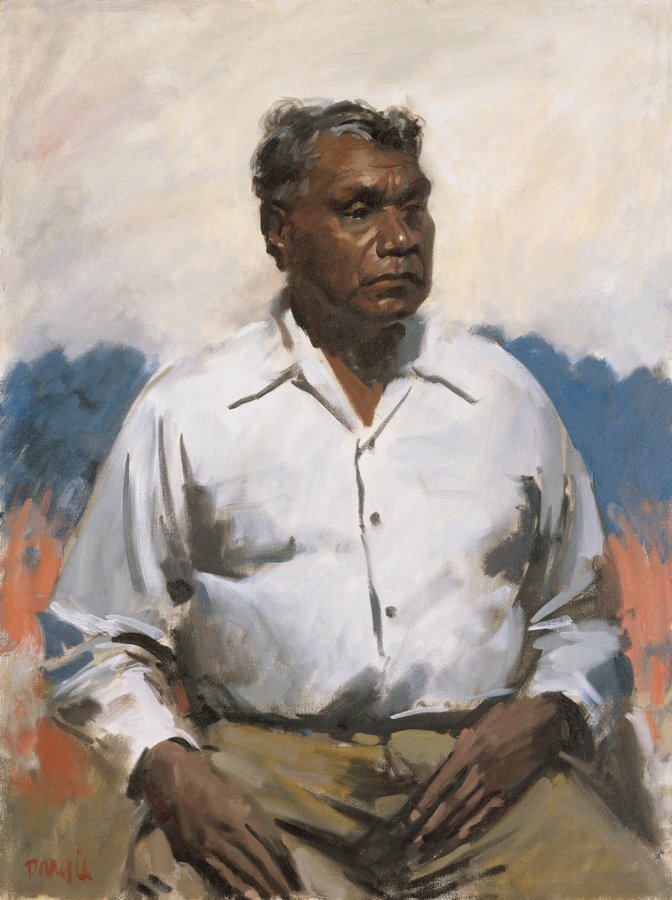
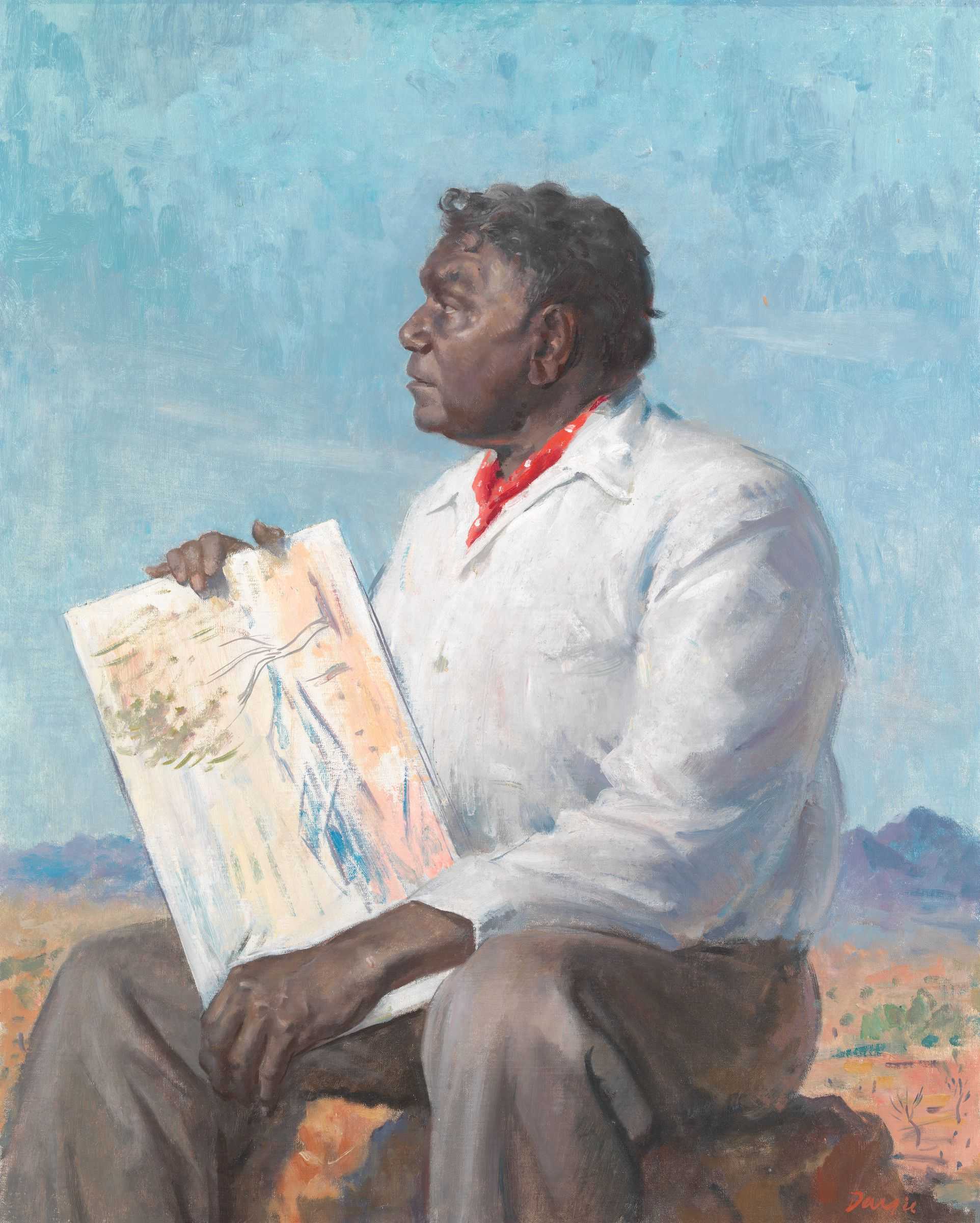
1 Portrait of Albert Namatjira, 1956. Queensland Art Gallery | Gallery of Modern Art, purchased 1957. © Estate of William Dargie. Photo: QAGOMA. 2 Albert Namatjira, 1958. © Roger Dargie and Faye Dargie, Currently on display. Both Sir William Dargie CBE.

During Albert’s 1956 trip to Sydney, the Argus reporter wrote that the artist was met by ‘Archibald Prize winner’ Sir William Dargie CBE ‘who will paint his portrait’. At the time Dargie was already a seven-time winner of the prize and had been commissioned to paint a portrait of Queen Elizabeth II to commemorate her first visit to Australia in 1954. His portrait of Albert would go on to win the 1956 Archibald Prize. While the papers reported that this was the artists’ first meeting, Dargie had previously painted with Albert near Tjoritja and was familiar with the colours and character of Aranda Country. Dargie later recalled in an interview with curator Ann Stephen, published in Queensland Art Gallery’s Brought to Light: Australian Art 1850–1965 (1988), that ‘We had agreed that he was going to sit for me. I liked his rebelliousness.’ It was noted by The Argus in January 1957 that the portrait was painted over ‘a series of pre-breakfast sittings which began about 5 a.m. and concluded about 8.30 a.m.’

In pose and attire, the figure of Albert in Vincent’s 2024 diptych directly references this Archibald-winning portrait by Dargie. Significantly, the announcement marked the first time the winning portrait was of a First Nations sitter, and the painting remained one of the most celebrated and recognisable of Dargie’s career. In February 1957 The Australian Women’s Weekly published a full-page colour reproduction of the portrait, and by May, Sydney’s Tribune reported that when it was purchased by the Queensland Art Gallery, the price was ‘stated to be the highest yet paid by the gallery trustees for a painting’.

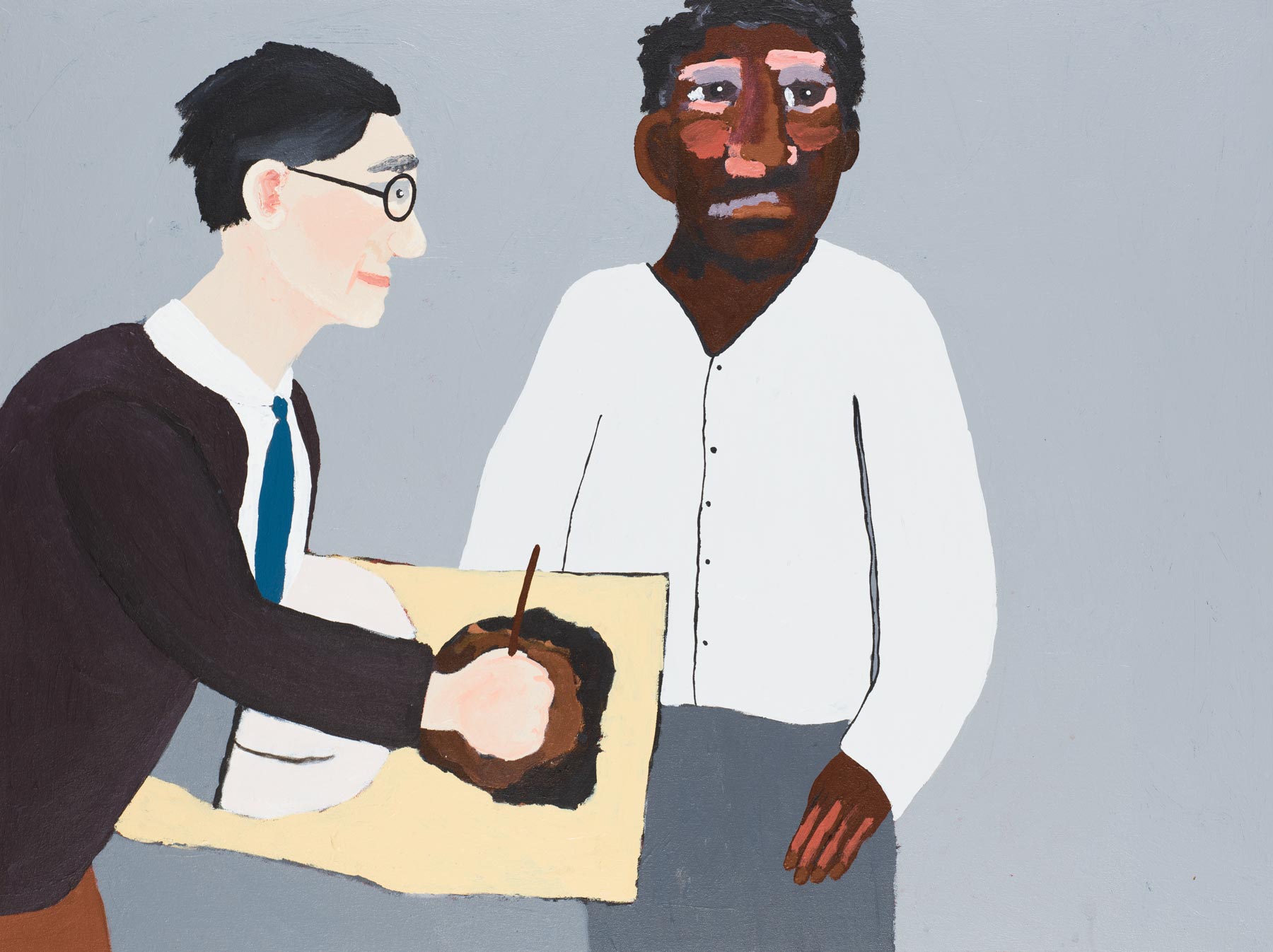
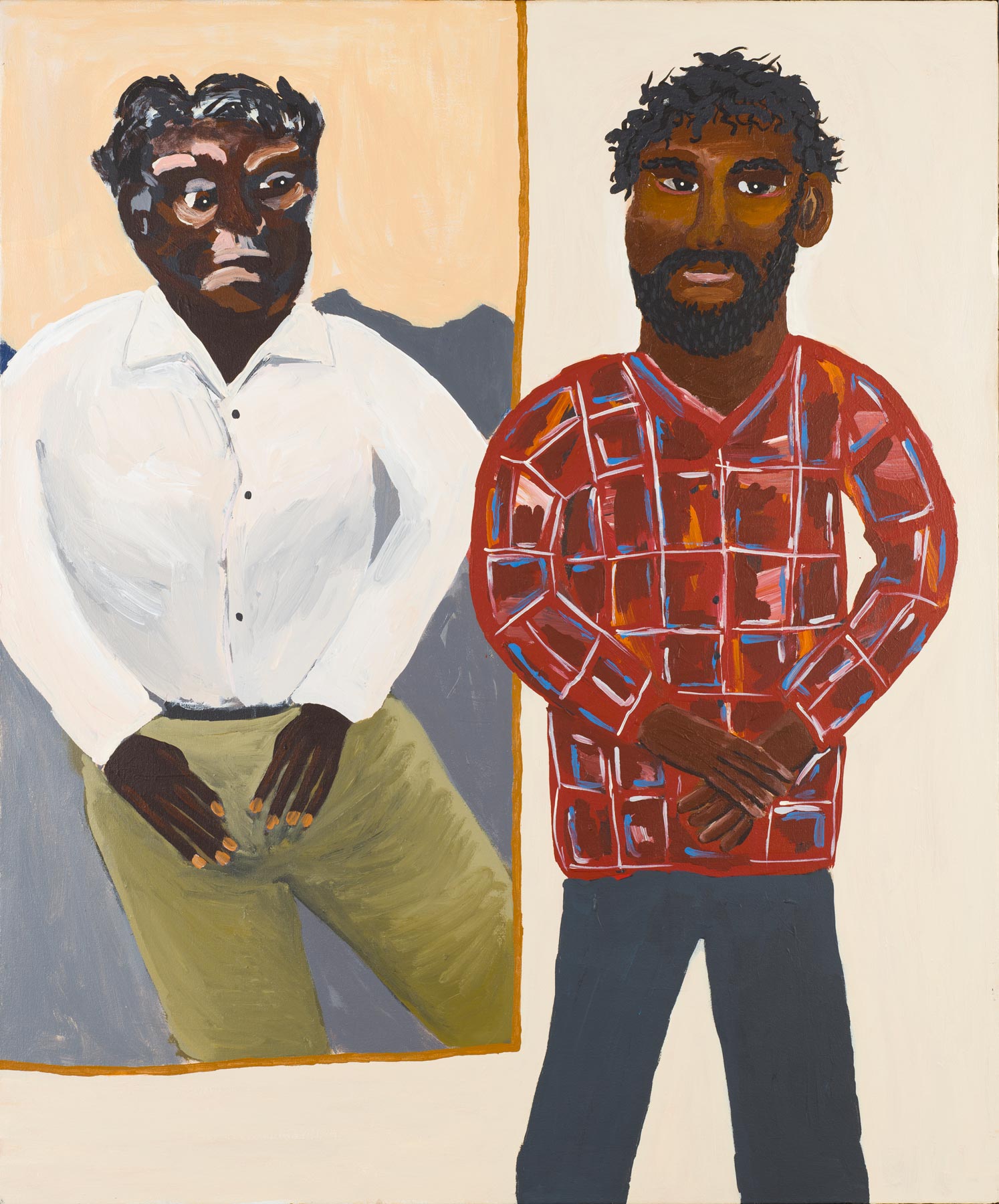
It was at the gallery in Brisbane that Vincent first viewed the painting of his great-grandfather. The younger artist made numerous sketches of the work over several hours before completing one of his earliest double portraits, Albert and Vincent (2014). In this work, a significant forebear to Albert and Vincent (2024), Vincent stands next to Dargie’s portrait hanging on the pale flatness of a gallery wall. The composition brings the artists side-by-side, mirroring each other through gesture. By pulling the Dargie portrait into his own work, Vincent engenders a reinvigoration and reclamation of the art-historical archive.

Dargie painted Albert again in 1958. In this later work, which is in the National Portrait Gallery collection, Dargie presented the artist in profile, looking out across the broad expanse of Aranda Country that spans the low horizon line. A watercolour sketch – another painting within a painting – is tipped towards the viewer. The composition recalls an image of Albert captured in a group of photographs taken around 1946. While the background of the 1956 portrait is scrubbed in with broad brushstrokes that approximate the rich colours of Country, this portrait situates the artist more convincingly against the landscape of Rwetyepme/Mount Sonder, which Dargie had painted and likely referred to as source material.

In the late 1930s Albert completed a small number of portraits, including Neey-too-gulpa [Ngalia tribesman] (c. 1937). The composition of Albert and Vincent echoes this early watercolour, with the figure of the Western Desert Elder in Albert’s work positioned in the right foreground as the landscape reaches out behind him towards a high horizon line. Noting Albert’s preference for painting ghost gums and the scrub-covered canyons and gorges of his Country over painting people, Wierdi curator Bruce Johnson McLean maintains that ‘Vincent’s paintings help to take the Namatjira story full-circle ... It’s interesting to imagine both Albert and Vincent walking into the small stone building [at Ntaria/Hermannsburg] in 1934, one man being enthralled by paintings of Country, the other engrossed by paintings of kin.’ In Albert and Vincent both artists sit alongside each other – Albert the subject of the first Archibald Prize-winning work to feature a First Nations sitter and Vincent the first First Nations artist to win the prize – in a shared legacy of family and history, and connection through Country.

Vincent Namatjira’s Albert and Vincent 2024 was acquired by the National Portrait Gallery with funds provided by the Calvert-Jones Foundation, Liangis Family Foundation and the Portrait Dinner Series.

‘When I look at his work and when I paint our Country myself, I can feel him teaching me too and I feel at peace.’


Studio self-portrait, 2018 Vincent Namatjira OAM. Art Gallery of New South Wales [240.2018] Gift of Geoff Ainsworth AM and Johanna Featherstone 2018 Photo: AGNSW. © Vincent Namatjira/Copyright Agency, 2022.
© National Portrait Gallery 2026
King Edward Terrace, Parkes
Canberra, ACT 2600, Australia

Phone +61 2 6102 7000
ABN: 54 74 277 1196

The National Portrait Gallery acknowledges the Traditional Custodians of Country throughout Australia and recognises the continuing connection to lands, waters and communities. We pay our respect to Aboriginal and Torres Strait Islander cultures and to Elders past and present. We respectfully advise that this site includes works by, images of, names of, voices of and references to deceased people.

This website comprises and contains copyrighted materials and works. Copyright in all materials and/or works comprising or contained within this website remains with the National Portrait Gallery and other copyright owners as specified.

The National Portrait Gallery respects the artistic and intellectual property rights of others. The use of images of works of art reproduced on this website and all other content may be restricted under the Australian Copyright Act 1968 (Cth). Requests for a reproduction of a work of art or other content can be made through a Reproduction request. For further information please contact NPG Copyright.

The National Portrait Gallery is an Australian Government Agency