Menu

The National Portrait Gallery acknowledges the Traditional Custodians of Country throughout Australia and recognises the continuing connection to lands, waters and communities. We pay our respect to Aboriginal and Torres Strait Islander cultures and to Elders both past and present.

Aboriginal and Torres Strait Islander viewers are warned that this website contains images of deceased persons.

Hidden in Plain Sight

by Rebecca Blake, 2 July 2025

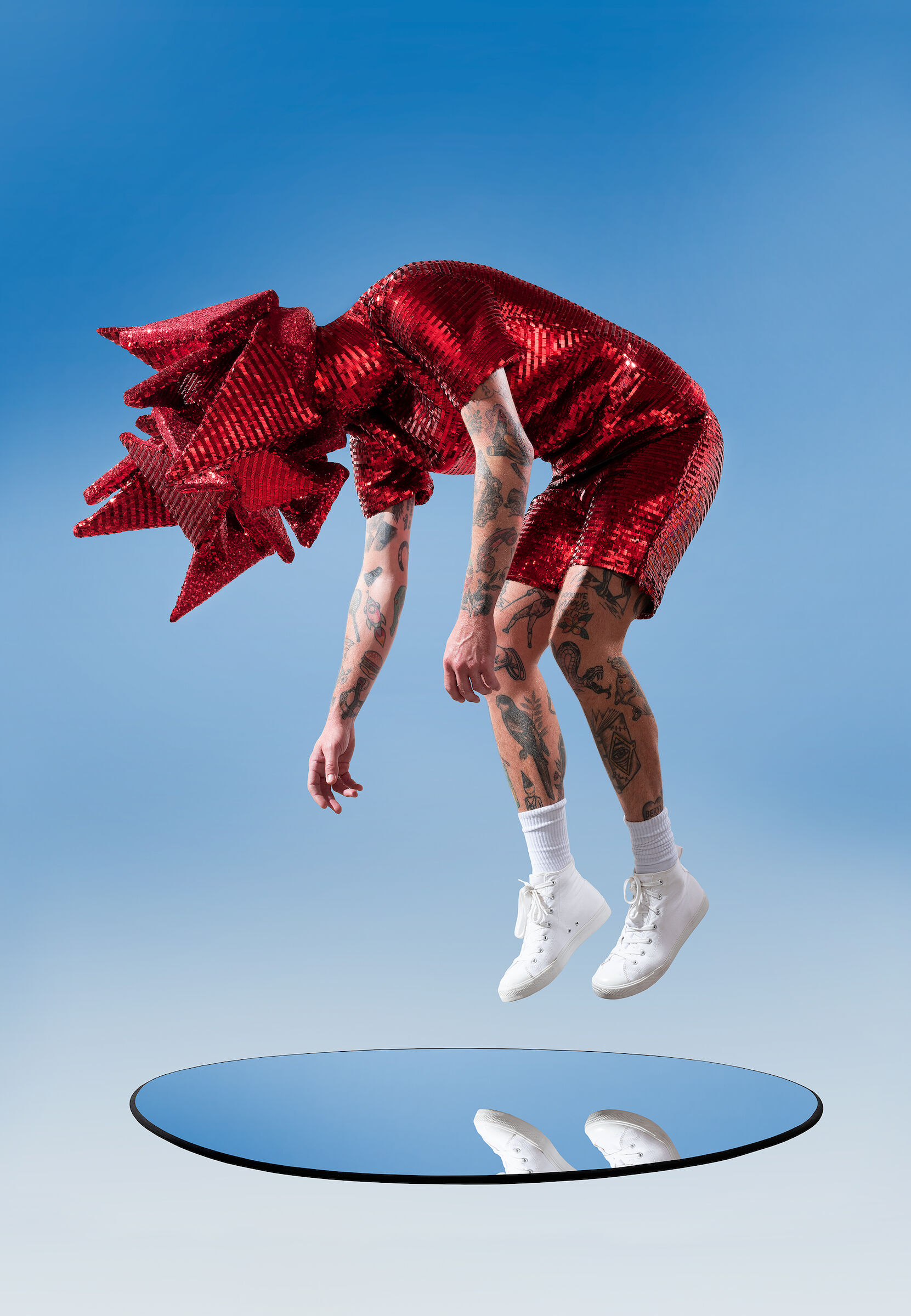
Mirror II, 2022 Gerwyn Davies

A figure sits on a milk crate, an esky by their side. Tattooed arms and legs emerge from a cocoon of orange traffic cones artfully wrapped around their head and torso. This self portrait is classic Gerwyn Davies: a camp celebration of low-brow Australiana.

Blending costume, sculpture, performance and photography, Davies upends the process of identity disclosure often connected to portraiture through playful evasion. In what he describes as ‘an act of queer photographic dis/appearance’, he deliberately conceals his face behind complex wearable sculptures that disguise and obscure rather than reveal.

Despite this, Davies’ self portraits are profuse with meaning. He deconstructs dominant narratives by taking camp performance and iconography, rearranging it, and turning it back on itself. In doing so, he reinvigorates camp as an aesthetic strategy and tool for queer representation.

Davies’ love of kitsch Australiana springs from his upbringing in the 1980s, a period of outlandish style and showy excess. Born in the Queensland city of Ipswich, Davies vividly remembers visiting Expo 88 in Brisbane, where Ken Done’s brashly colourful AUSTRALIA sign greeted swarms of eager visitors.
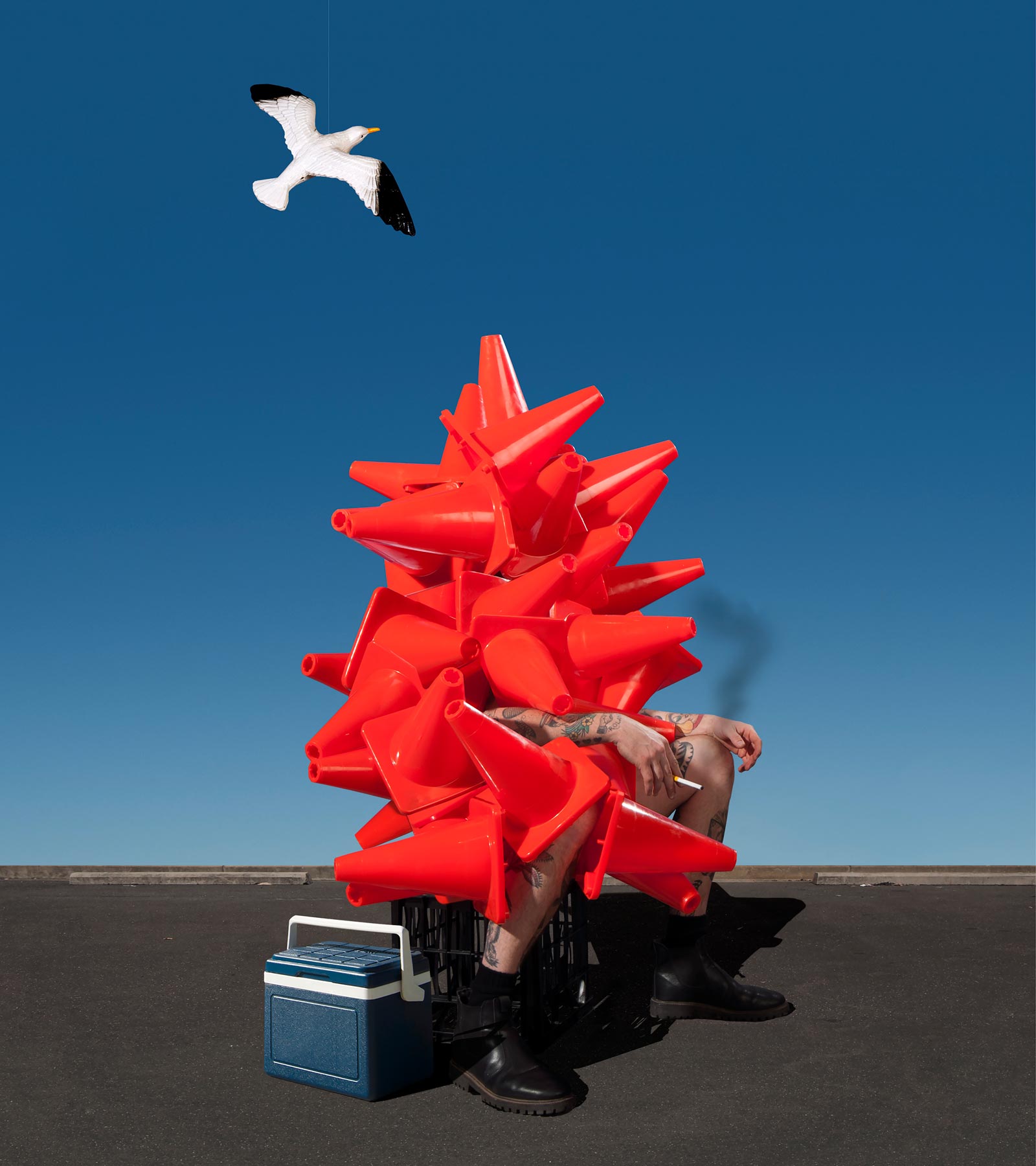
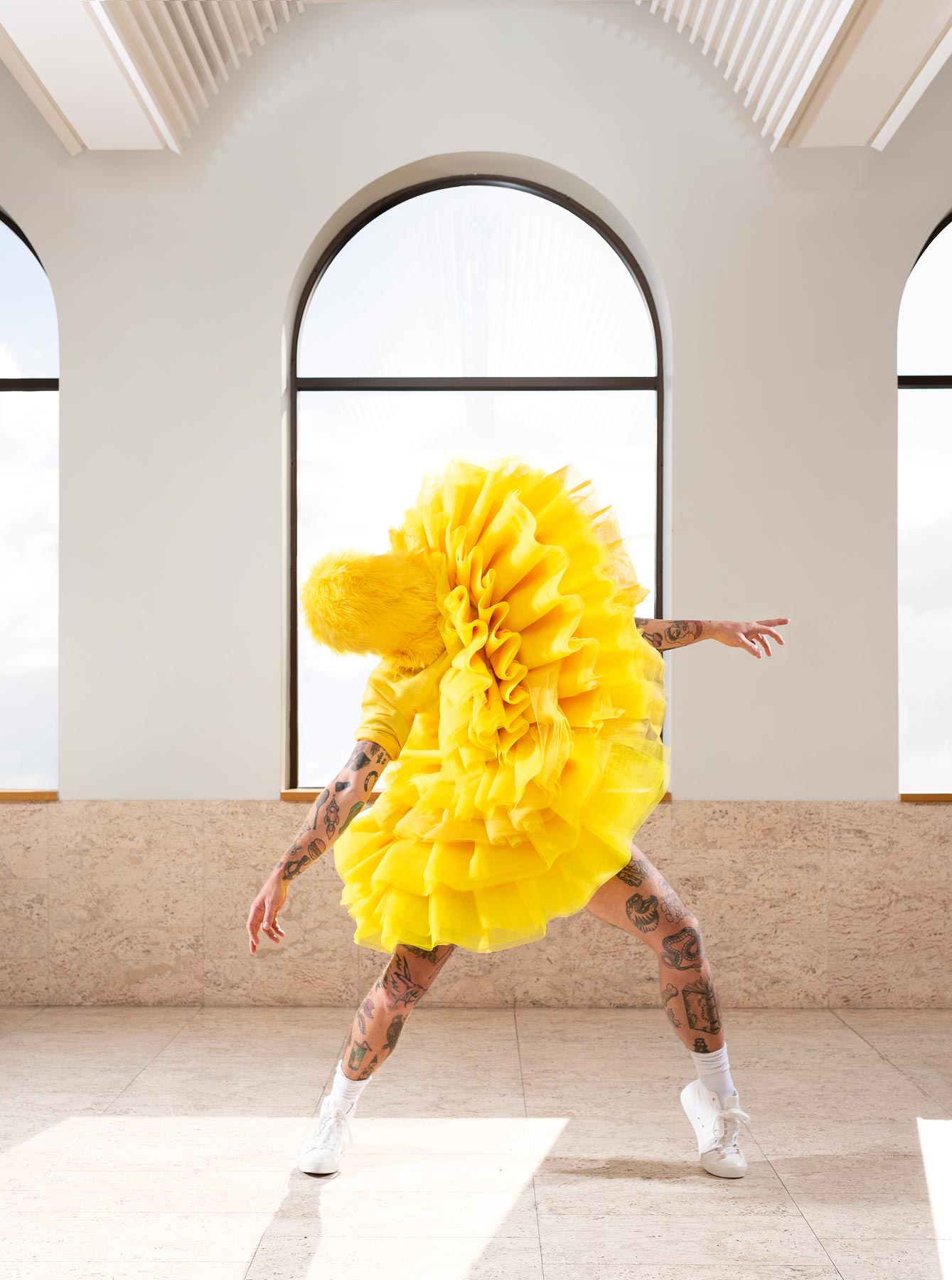
1 Construction, from the series ‘Heatwave’ , 2017. 2 Grand, from the series ‘Pleasure’, 2022. Both Gerwyn Davies. Courtesy the artist © Gerwyn Davies

‘I think all that spectacle, the hypercolour, the fabricated landscapes, has impacted me on a cellular level,’ Davies says. ‘I like to celebrate the outmoded, the hyper-touristy, the garishly colourful, the deeply suburban, the fibreglass and fake, and it is out of a deep affection rather than mocking condescension.’

All of Davies’ interests and influences come together in Bather, his finalist work in the 2025 National Photographic Portrait Prize. Set against a flawless white sandy beach and blue sky, the artist dominates the centre of the composition, disguised by a tangle of bubble-gum pink pool noodles. In his left hand is a Castaway milkshake cup, an iconic emblem of Australian summer, but it would be impossible for the subsumed figure to consume this beverage. The subtle humour of this gesture emphasises the incongruity of the scene.

Cheeky nods to Australian culture are peppered throughout Davies’ works. In his portrait Croc (2025) the artist is adorned with green inflatable crocodiles and matching ‘Crocs’ clogs. In Prawn (2016) he admires the iconic ‘Big Prawn’ in Ballina, northern New South Wales, a beloved feature of road trips for many generations of Aussies, dressed as a human-size version.

The interface between the artist and his immediate surrounds is a constant in Davies’ self portraits, from stark architectural facades to tourist spots dripping in saturated colour. ‘I am often hunting for these things across the country, remnants of perhaps a less sophisticated moment in time,’ says Davies. He pairs these memorable locations with equally kitsch costumes made of latex, foam, sequins, fake fur or even astroturf. Each one is different from the last, the only constant his tattooed limbs that protrude from the splendorous forms and anchor his hidden body.

Davies experimented with making costumes while studying photography at Queensland’s College of Art at Griffith University, sourcing his materials from dollar-stores and cheap fabric shops, and using trial and error to construct something wearable. He now has this process down to a fine art, fabricating these bold, over-the-top confections by hand at his Sydney studio. Davies takes fabrics and everyday objects – the glitzier, shinier or gaudier the better – and toys with them, teasing and manipulating them to make something magical, sculptural and new. ‘I am looking for surfaces that shimmer and shine, materials that catch and reflect light, that will animate under studio lighting and come alive before the camera.’

This can be seen in works such as Davies’ 2022 National Photographic Portrait Prize work Mirror II (2022), where the artist seemingly floats above a mirror in a glittering headpiece of three-dimensional triangles, or Adobe (2024), where the costume resembles a sequined blonde wig that completely obscures the artist’s face and head.

For Davies, the photo shoot is intuitive – he often doesn’t try on the costume until it is time to photograph it, so he sees it for the first time in the viewfinder: ‘That’s when I know whether the image will be a triumph or a disaster.’ He goes back and forth between the set and the camera until he gets the perfect shot, which is then edited to further enhance the image so that it takes on ‘a slipperiness, a queer synthetic glow’.

Davies disturbs the familiar and makes it strange, conjuring fantasy that suspends the moment of recognition. ‘My desire is that for the viewer, it isn’t immediately clear that this is indeed a photograph they are looking at.’ Attracting attention while simultaneously resisting disclosure and examination, Davies’ costumes function as masks that allow the artist to hide in plain sight.

The National Photographic Portrait Prize is on show at the National Portrait Gallery from 16 August to 12 October 2025.

‘I like to celebrate the outmoded, the hyper-touristy, the garishly colourful, the deeply suburban, the fibreglass and fake.’

Related people

Gerwyn Davies

© National Portrait Gallery 2026
King Edward Terrace, Parkes
Canberra, ACT 2600, Australia

Phone +61 2 6102 7000
ABN: 54 74 277 1196

The National Portrait Gallery acknowledges the Traditional Custodians of Country throughout Australia and recognises the continuing connection to lands, waters and communities. We pay our respect to Aboriginal and Torres Strait Islander cultures and to Elders past and present. We respectfully advise that this site includes works by, images of, names of, voices of and references to deceased people.

This website comprises and contains copyrighted materials and works. Copyright in all materials and/or works comprising or contained within this website remains with the National Portrait Gallery and other copyright owners as specified.

The National Portrait Gallery respects the artistic and intellectual property rights of others. The use of images of works of art reproduced on this website and all other content may be restricted under the Australian Copyright Act 1968 (Cth). Requests for a reproduction of a work of art or other content can be made through a Reproduction request. For further information please contact NPG Copyright.

The National Portrait Gallery is an Australian Government Agency