Menu

The National Portrait Gallery acknowledges the Traditional Custodians of Country throughout Australia and recognises the continuing connection to lands, waters and communities. We pay our respect to Aboriginal and Torres Strait Islander cultures and to Elders both past and present.

Aboriginal and Torres Strait Islander viewers are warned that this website contains images of deceased persons.

Floral Extravaganza

by Serena Bentley, 2 July 2025

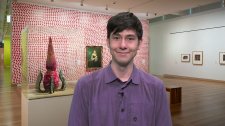
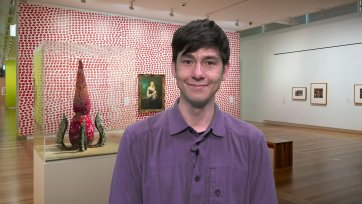
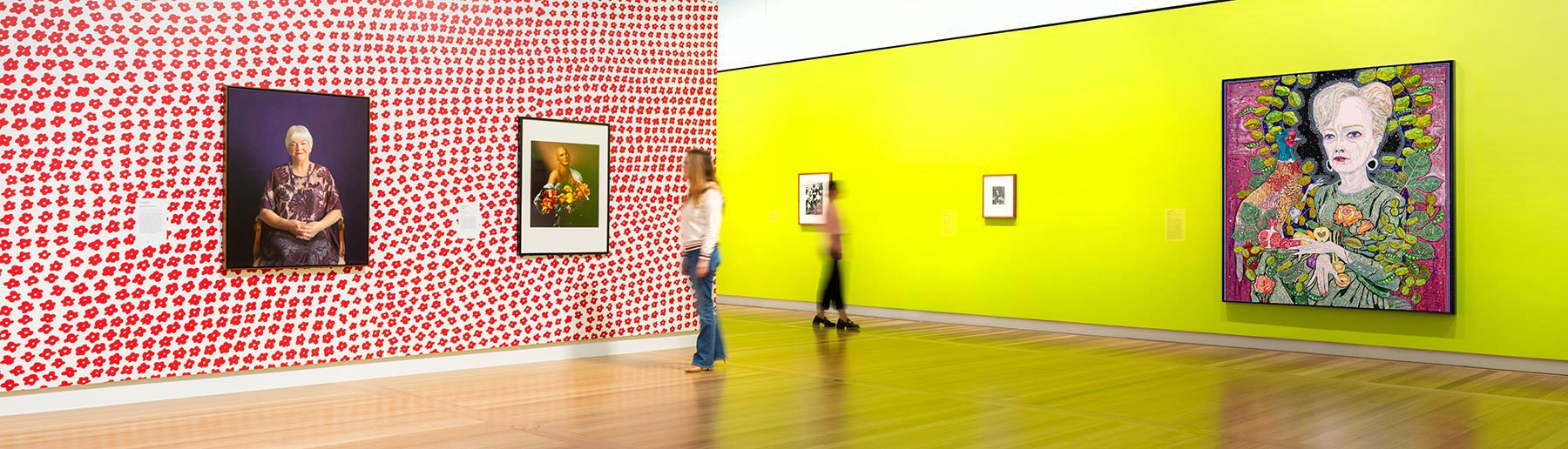
In Bloom exhibition, May 2025

A riot of colour and floral exuberance, the National Portrait Gallery collection show In Bloom reveals complex examinations of ecology, colonisation, abundance and queerness within the realms of portraiture. Flowers have long been used as symbols to convey messages of personal, cultural and religious significance. Within floriography, or the language of flowers, each flower has its own meaning, which can also be influenced by its variety, colour and quantity.

In Bloom explores how floral symbolism is used in portaiture as a marker of identity. Traversing much-loved and lesser-known collection works both historical and contemporary alongside a selection of key loans, In Bloom features socialites, chefs, musicians, actors, doctors, politicians and artists unified by their accompanying floral markers.

One of the key themes in the exhibition is the tension between the perceived binaries of the ‘natural’ versus the ‘unnatural’, employed by artists to complicate notions of ‘otherness’ and place. Accordingly, endemic and introduced plants and flowers are used by artists to interrogate our relationships to the land and to explore broader themes of migration and the diasporic experience.

Thailand’s national plant, Thai orchids, for example, are used by Nathan Beard throughout his practice as a cultural signifier to interrogate notions of value and the slipperiness of his own Australian-Thai heritage. In Making Chinese shadows (sixteen silhouette portraits), Chinese-Australian artist Pamela See uses totemic flower papercuts as an allegory for the migrant experience. And Sāmoan artist Angela Tiatia literally consumes the Western stereotype of the sexually alluring ‘dusky maiden’ by devouring an entire hibiscus in her moving image work Hibiscus rosa sinensis.
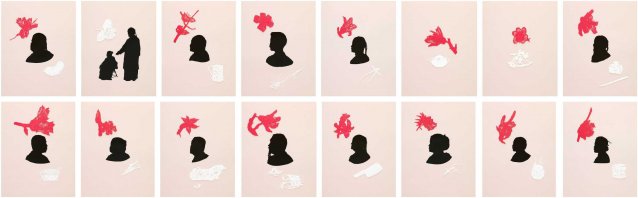
Born in Brisbane, Pamela See (Xue Mei-Ling) is a Chinese-Australian artist who questions, honours and investigates her cultural inheritance and family experience through her practice, which connects the traditions of European silhouette portraiture and Chinese papercutting from Guangdong Province, where her mother’s family originates. In Making Chinese shadows (sixteen silhouette portraits), a series of 16 intricate papercut silhouette drawings, See represents members of the Chinese-Australian community who made major but often unrecognised contributions to Australian society in the 19th century. Each work incorporates a silhouette based on a photograph, an object representing their achievement, and a floral symbol of an introduced, invasive or endemic species including red silk cotton tree flower (symbolic of Guangdong Province), jasmine flower, common heath and hibiscus.

What’s your personal connection to flowers? My mother studied plant pathology in Taiwan during the late 1960s. My parents cultivated many species of flora from their acreage in Rochedale, Queensland. I used to watch them dividing orchids and grafting fruit trees. Picking flowers became a pastime. Many of the species I now depict grew on their property, from camellia to jasmine. Although we never made tea from those actual specimens, my mother firmly believed in their medicinal applications. As such, floral teas were served in our house to dispel ‘heat’.

How do flowers influence your approach to making art? Jianzhi, or Chinese papercutting, heavily features totemic representations of flowers. In fact, ‘window flowers’ are a distinct genre. The symbols are thought to evoke their respective powers. For example, chrysanthemums promote longevity. It seemed natural to employ them in my practice. As my interest in migration developed, floral emblems became a vehicle for expressing the birthplaces of my sitters. Overall, they present geographic markers which viewers may recognise.

How do floral symbols express identity or contribute to storytelling in your work? Flowers offer a nuanced avenue for expressing identity and geography. Using a combination of introduced and endemic species of flora has enabled me to place a subtle dialogue about migration into many public places. [See also translates her papercut designs into public artworks made from bronze and steel.] A facade or ceiling of a building. A street corner. We cannot dictate who will encounter this artwork. I also wouldn’t wish to cause passersby offense. But I can leave a clue in these artworks, for viewers who are looking for them. It is not unlike mourners marking the site of a car accident with a bouquet. Using flowers, I can acknowledge, and attempt to appease, the spirits of past victims of interracial conflict.

What’s your favourite flower? I would have to say that jasmine is among my favourites. Some varieties are considered invasive in Australia. However, there is a patriotic song in China titled ‘Mo li hua’ [Jasmine Flower]. They symbolise purity there. It’s also the floral emblem of Fuzhou, which is the capital of my paternal family’s home province: Fujian. We used to drink jasmine tea with dumplings. What I love most is that the blooms fill hot summer nights with their fragrance.

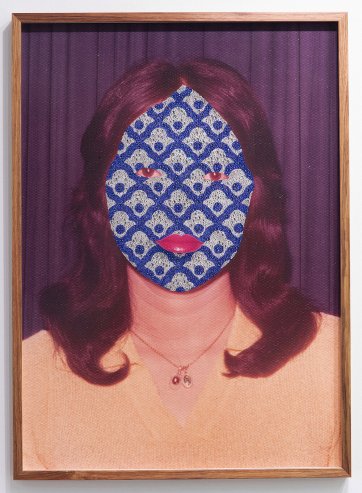
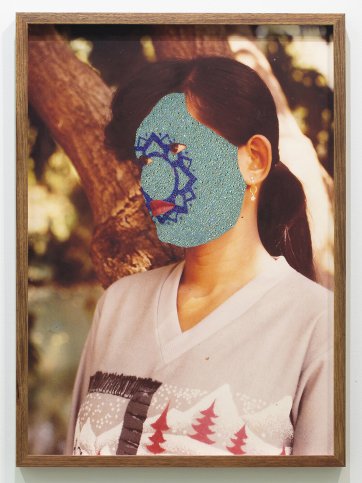
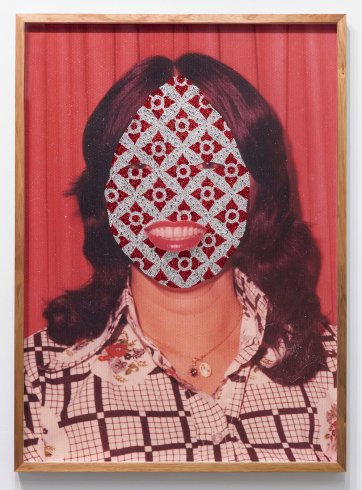
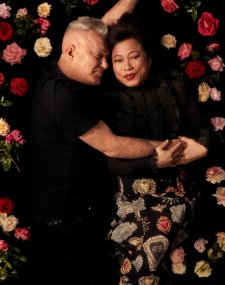
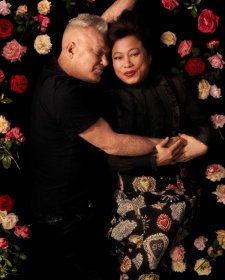
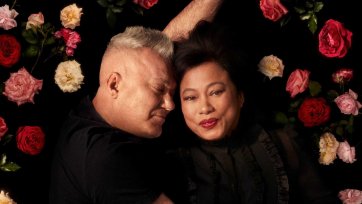
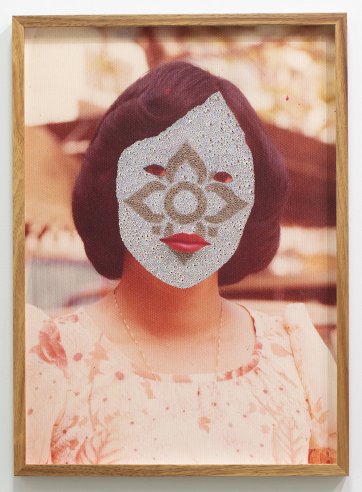
1 Siamese Smize (with Lotus), 2018. 2 Siamese Smize (with Thai Ceramic Pattern), 2018. 3 Siamese Smize (with Thai Floral Vector), 2018. 4 Siamese Smize (with Thai Silk Pattern), 2018. All Nathan Beard. Courtesy of Nathan Beard © Nathan Beard

Nathan Beard often combines personal family archives and memories with broader cultural signifiers of his Thai heritage to explore the complexities of ‘authenticity’ and the diasporic experience. His suite of Siamese Smize photographs feature manipulated family portraits found in the artist’s mother’s abandoned family home in Thailand. ‘Smize’, a slang term for smiling with the eyes, is here amalgamated with ‘Siamese Smile’ – a Thai tourism term from the 1980s used to describe the perceived friendliness that prevails as a Thai stereotype within a Western context. Beard’s family members are bedazzled and partially obscured by Swarovski crystals arranged into Thai floral patterns traditionally found on ceramics and silks, that equally reference a contemporary South-East Asian aesthetic in clothes and accessories. These works in their painstaking labour of application also memorialise the subjects of the portraits, honouring Beard’s relation to them and to his own heritage.

What’s your personal connection to flowers? My mother and grandmother were both passionate gardeners, and their gardens were always bursting with colour from a range of flowers. In my mother’s house her Buddhist shrines were decorated with bunches of flowers she picked from her garden, as well as a range of plastic flowers which we’d have to clean, alongside bronze statues of monks and the Buddha. The flowers that always stood out to me from her garden were from Crown of Thorns plants, which she grew from seeds smuggled into Australia from her home in Thailand. Combined with the herbs and vegetables she grew from Thailand, her garden in Australia became an important space through which she was able to maintain a profound cultural connection.

How do flowers influence your approach to making art? Floral offerings and decorations are a prominent visual feature throughout much of Thai culture. My art making is very much engaged with unpacking expressions or expectations of ‘Thai-ness’, and the symbolism and beauty of flowers in this context is an incredibly evocative portal for audiences. The prevalence of orchids throughout Thai culture, as their national flower, is also a recurring motif in my work and research, both as a symbol for nationalism, and a marker of authenticity for businesses throughout the Thai diaspora.

How do floral symbols express identity or contribute to storytelling in your work? Floral motifs occur throughout multiple entry points into Thai culture, and so these elements feature in my work as familiar symbols for audiences to recognise. These have included references to floral garlands called phuang malai, sculpted forms called bai sri which are made as offerings at shrines and temples, floral designs found in traditional textiles and decorative mosaic patterns, and symbolic hand gestures from traditional Thai dance. Through these recognisable aesthetic markers, the works engage with complex issues surrounding ideas of cultural authenticity, and how expressions or understandings of cultural identity might be shaped by a range of external influences and expectations.

What’s your favourite flower? Dendrobium Memoria Princess Diana, a commemorative orchid hybrid produced by the Singapore Botanic Gardens one month after Diana’s death in 1997. The botanic gardens feature a range of orchid hybrids named for celebrities and guests to the country, but this was the first example of an orchid to be named for a subject posthumously.

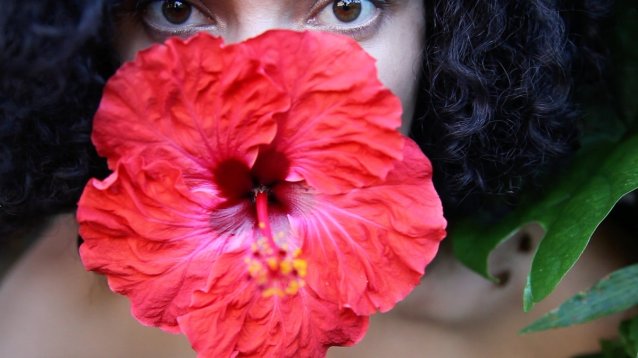
Deeply informed by her Sāmoan heritage, much of Angela Tiatia’s work critiques the commodification of Pacific Island women in Western popular culture. In Hibiscus rosa sinensis the artist appears surrounded by lush foliage in close up, a bright red hibiscus protruding from her mouth. In traditional Sāmoan culture the hibiscus, when placed behind the ear, can signify relationship status and sexual availability. Behind the right means you’re looking; behind the left means you’re taken. In this video work, however, Tiatia creates a counternarrative. Staring steadily at the viewer, she eats the hibiscus and in doing so rejects the romanticised trope of the ‘dusky maiden’. Tiatia’s consumption of this symbolically loaded bloom is an exercise in taking the power back – she situates herself as protagonist, rejects the colonial gaze and contests the reduction of Pacific Island women and their bodies to motifs for tourist attractions and souvenirs.

What’s your personal connection to flowers? Within a Sāmoan family, flowers are inescapable – whether printed on fabric, blooming in our gardens, draped over framed family portraits, or worn to decorate our bodies. They are an integral part of the Sāmoan aesthetic, providing an immediate connection to our culture. Flowers are constant reminders of who we are, where we were raised, or of a particular family member who loved them deeply. For example, my mother lined the ceilings in our home with red plastic roses, she had them everywhere! And now she has passed, I am constantly reminded of her.

How do flowers influence your approach to making art? Flowers offer both a symbolic and aesthetic foundation on which to build my work. They are immediately enticing to most people. In moving images, their appeal and beauty can be used to draw viewers into the work – that’s half the challenge completed. The next is keeping the audience with you. Symbolically, flowers can spark curiosity, encouraging the audience to linger a little longer. There are so many layers of meaning through species and colours, especially when combined with other elements. I often use flowers to create a space where the audience can reflect on their own connections to a particular flower, and from there, I guide them through what it means to me. Somewhere in the meeting of these two interpretations, something new can emerge.

How do floral symbols express identity or contribute to storytelling in your work? In the Pacific, florals carry many layers of meaning, depending on who is wearing them. In my practice, I use the flower to assert a strong feminine energy. When contrasted with the perceived delicateness of the flower itself, this creates a tension – one that opens space for reflection and complexity for myself as an artist to work through.

What’s your favourite flower? The frangipani.

© National Portrait Gallery 2026
King Edward Terrace, Parkes
Canberra, ACT 2600, Australia

Phone +61 2 6102 7000
ABN: 54 74 277 1196

The National Portrait Gallery acknowledges the Traditional Custodians of Country throughout Australia and recognises the continuing connection to lands, waters and communities. We pay our respect to Aboriginal and Torres Strait Islander cultures and to Elders past and present. We respectfully advise that this site includes works by, images of, names of, voices of and references to deceased people.

This website comprises and contains copyrighted materials and works. Copyright in all materials and/or works comprising or contained within this website remains with the National Portrait Gallery and other copyright owners as specified.

The National Portrait Gallery respects the artistic and intellectual property rights of others. The use of images of works of art reproduced on this website and all other content may be restricted under the Australian Copyright Act 1968 (Cth). Requests for a reproduction of a work of art or other content can be made through a Reproduction request. For further information please contact NPG Copyright.

The National Portrait Gallery is an Australian Government Agency