Menu

The National Portrait Gallery acknowledges the Traditional Custodians of Country throughout Australia and recognises the continuing connection to lands, waters and communities. We pay our respect to Aboriginal and Torres Strait Islander cultures and to Elders both past and present.

Aboriginal and Torres Strait Islander viewers are warned that this website contains images of deceased persons.

The Art in the Optics

by Jacqueline Maley, 2 July 2025

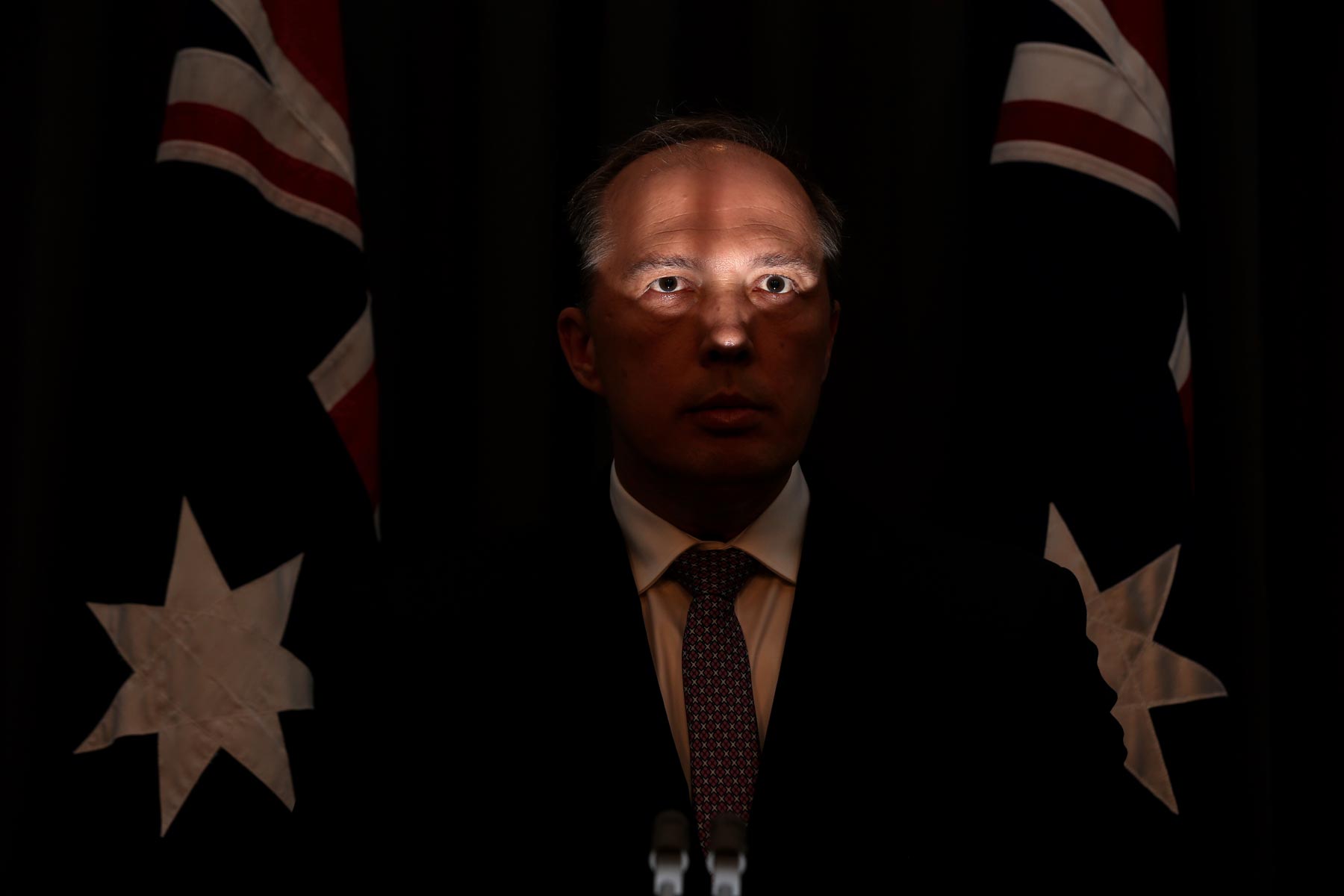
Peter Dutton, 2016. Photo: Alex Ellinghausen. Sydney Morning Herald

Each year a prominent Australian speaker is invited by the National Portrait Gallery to deliver a lecture that explores the intersection of portraiture and identity. In this edited extract from the 2025 Andrew Sayers Memorial Lecture, writer and columnist Jacqueline Maley lifts the curtain on how political portraiture is used as a tool to change hearts and minds, acknowledging that the formidable power it wields can be a double-edged sword.

olitical portraits capture defining political moments and reframe national conversations. But what, if anything, do they reveal about these people we see so much of in the daily news? How do these images connect with, and even influence, the reputation and identity of the politicians who lead us?

Now, I show you this portrait with profuse apologies to former Opposition Leader Peter Dutton because it is on the public record that his media minders really, really didn’t like this picture. It was taken in 2016 in Parliament House, by the renowned press gallery photojournalist Alex Ellinghausen. Alex works for the Sydney Morning Herald and the Age, and he is one of the best in the business.

The photo was taken on budget day, when most of the journalists in the press gallery are in the hostage situation which is known as the budget lock-up. But Dutton, who was then immigration minister, wasn’t in the lock-up. He called a press conference in what’s known as the Blue Room of Parliament House.

Alex Ellinghausen also wasn’t in the lock-up. And as a consequence, his workload was a little lighter that day. He had a little more time and freedom to experiment. He positioned himself below Dutton, who was at the podium speaking, and when he pressed the shutter button, the light projected upwards, the podium cropped the light, and the result was the mask-like effect we see.

When Alex went back to the bureau office, he showed the photo to his colleague Andrew Meares, a multi-award-winning photographer who was with the Herald for nearly three decades. Mearsey, as we call him, told me that when they reviewed the picture, they knew it would be controversial and unflattering, but asked themselves, ‘On what grounds would we censor it?’

They couldn’t answer that question, so, in the interests of objectivity, they decided to file it to the editors. They decided that if they censored it, that would be a political act in itself.

Stephanie Peatling, a senior editor still with the Herald, tweeted the picture with the caption ‘Eek’, and Dutton’s media team saw it, and rang to ask her to remove it. After some negotiation, she agreed, but on the proviso that she post a statement about why she was removing it.

But as we know, despite its ephemeral nature, social media does not forget. It was a classic own goal. Dutton’s office had tried to shut the image down, but they ended up publicising it more widely. So why did Dutton’s office care so much about one bad picture? Because they knew its potential power.

A politician can do many things in their career, but one or two images of them may end up summing them up for voters in a way that they don’t like. Or that they think is unfair. Untruthful, even. That is the power of a portrait.

That is why politicians want so badly to control their images – because they know that when the image is out there, published, in the political ether, it is not their property anymore. It doesn’t belong to them. It belongs to us, the voters. It becomes ours.

The combination of digital photography, smartphones and the internet has led to an explosion of images. Those images can be distributed globally in a near-instant process we call ‘going viral’. We live in an age where the manipulation of images is commonplace, and increasingly hard to spot. No wonder politicians want to assert some control, some sovereignty, over their own images.

It has become commonplace for prime ministers and opposition leaders to have their own official photographers while, every day, politicians’ offices send out alerts for what are known as ‘picfacs’, which are stage-managed picture opportunities meant to document the rather visually boring business of government.
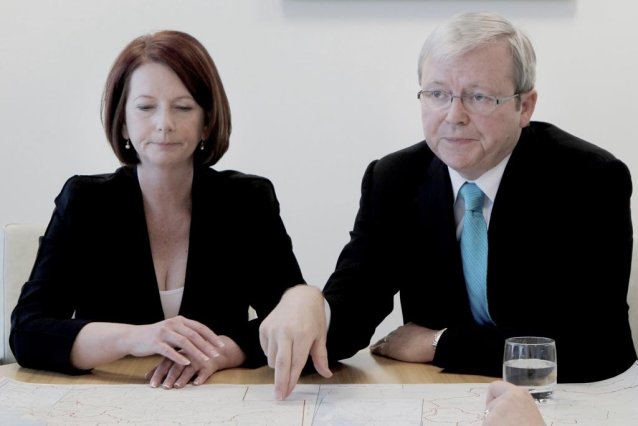
Of course sometimes picfacs can go terribly wrong – case in point, this staged photo-opp of Kevin Rudd and Julia Gillard during the disastrous 2010 election campaign, not long after Gillard had deposed Rudd for the prime ministership. It was meant to show a united front. But the body language does not lie.

The more that politicians and their offices, not to mention AI models and Russian internet trolls and malevolent state actors and god knows who else, manipulate images and try to control the taking of those images, the more urgent and important real political portraiture becomes. Because in a post-truth world, it is still a source of truth.

There are two forms of political portraiture I want to talk about. Each form has a different intention and a different place, but each informs the other, and both have an equal role in this ecosystem of political truth I am trying to invoke.

The first kind are the formal political portraits, the ones that are considered and commissioned, the ones that historically have been of bearded white men with stern expressions. In these kinds of formal political portraits, the sitter gives time to the artist or photographer, and there is usually some trust or rapport between the two. These portraits signify honour and status, particularly when they’re displayed in a public place like this, our esteemed National Portrait Gallery.

The other form of portraiture I want to discuss is political news photography. These are the moments captured candidly during the daily tumble of the news cycle. These on-the-fly photographs give ordinary voters a true sense of an event, rather than the stage-managed version that serves as little more than propaganda for the politician. These images lift the curtain a little bit. They let us in. These are the kinds of photographs we love to see during an election campaign.

Mike Bowers, the legendary press gallery photographer, told me that the former senator Stephen Conroy once said to him: ‘You guys are snipers, and you’re out to kill us.’ The remark is telling because it’s a little bit true, and because, when it comes to these kinds of portraits, we, the voters, know whose side we are on. We are with the snipers. We would rather look at something with more drama, more movement, more truth than a boring old picfac. We would much rather look at a photo of Tony Abbott eating an onion.

There is a fundamental tension in political portraiture that doesn’t exist in other kinds. It is the conflict between what the subject wants to project and what the portraitist sees, with the added delicious tension of what we, the viewer, the voter, bring to what we see. That’s where the alchemy happens. That’s where the uncontrollable happens. That’s where freedom is, and that’s where democracy is.

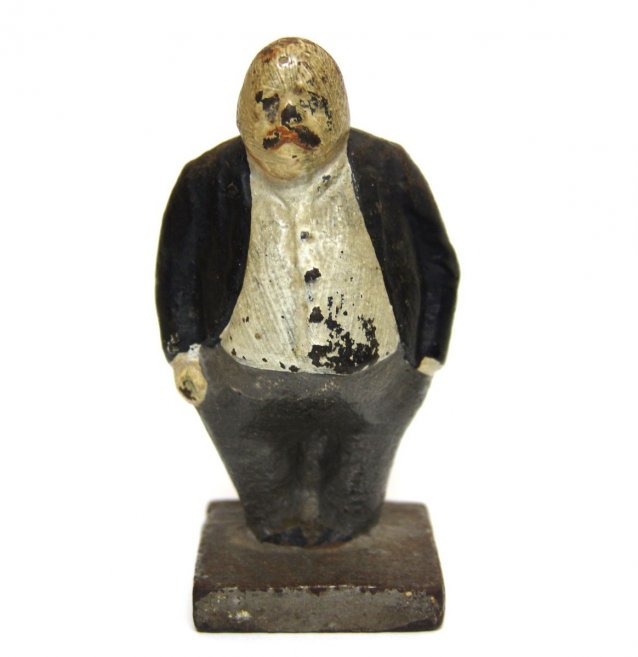
Only 17 of Australia’s 31 prime ministers are in the National Portrait Gallery collection, and it is a delightfully random selection. The first one, in chronological order, is poor old George Reid, whose portrait is in the form of a paperweight made from Lithgow iron. Reid was rather a rotund man and cartoonists had a lot of fun with him. He was only PM for 10 months, resigning on 5 July 1905. But during his prime ministership he made a mark – most notably, he established an arbitration court for settling industrial disputes, a major federal reform. By all accounts, Reid had a good sense of humour, so perhaps he wouldn’t mind being immortalised as a paperweight that makes him look a bit like George Christensen in a morning suit. But the portrait, such as it is, tells us a fair bit about his place in history, or how his place in history has been treated, thus far.

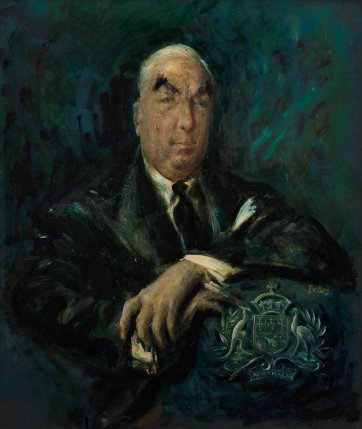
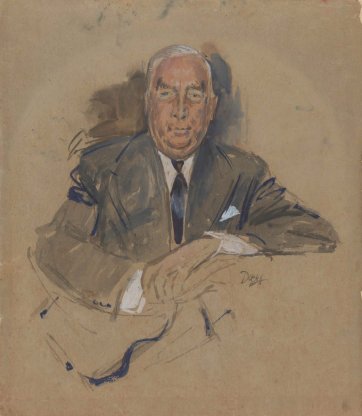
1 Sir Robert Menzies, 1960 William Dobell. Art Gallery of NSW, Gift of Time Magazine 1962. © Courtesy Sir William Dobell Art Foundation/ Copyright Agency, 2025. Photo © Art Gallery of NSW OA10.1962. 2 Sketch for Prime Minister Robert Menzies, 1960 Sir William Dobell OBE. © William Dobell/Copyright Agency, 2024.

Compare and contrast to another of the Gallery’s portraits – a sketch by Sir William Dobell of Robert Menzies. Dobell had been commissioned by Time magazine to paint Menzies for the cover of its April 1960 issue. Dobell only got two sittings with the PM, and this was one of his preparatory sketches. In it, Menzies projects power. He is clear-eyed, his gaze is straight, and the way his hands are placed seems to show that he is at ease with that power, and himself. The final version is held by the Art Gallery of NSW. Dobell has inserted an Australian coat of arms in there. Menzies is much larger than the figurative depiction of the nation over which he presides. But how much of this meaning can we eke from the painting alone, and how much meaning are we placing on the painting, knowing what we know now about Menzies, a political giant?

This is the magical part, the alchemy I referred to before. Dobell had his intention going into this portrait session. The prime minister himself presumably knew what he wanted to project, more or less. The portrait is in dialogue with the political discourse around Menzies, at this point in our history. And ultimately, the real meaning of the portrait comes from us, the people.

No talk about political portraiture can happen without mention of Tony Abbott, who was an absolute gift in that regard. There is the famous photograph of him ironing, there is the onion-eating photo I mentioned before. This is just a random selection, but it shows the influence of political portraiture in shaping a leader’s image.

Abbott’s controversial chief of staff Peta Credlin was renowned for policing those images because she knew precisely what their power was. But actually, the images are given meaning through their context. As we look at them, we are participating in the stories behind the photographs. It is a sort of puzzle – we are putting things together, putting together the stories and images, to work out who Tony Abbott really is. These images have accrued layers of meaning since they were taken, as we stand back with time and distance to assess Abbott’s political legacy.

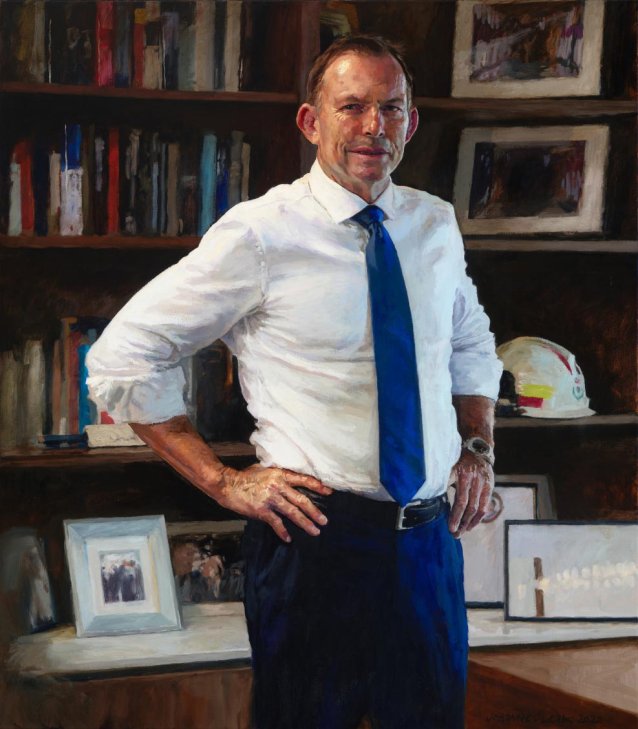
Now let’s look at a portrait that Abbott sanctioned – his official prime ministerial portrait by Johannes Leak which hangs in the Prime Ministers Gallery in Parliament House – the last resting place of stern white men, and, of course, one woman. He is commanding, with a powerful masculine stance, both hands on his hips, looking off to the side, not at the viewer. His sleeves are rolled up, showing he is a man of action, and his firefighter’s helmet is placed among books and framed photographs on the shelves behind him. It is a frank, faithful and, I would say, very true portrait of an extraordinary prime minister. It is the opposite of the sniper trying to kill him. It is a friendly portrait by an artist the sitter trusts. But he has managed to capture some truth.

Of all the artists and photographers I spoke to researching this talk, and of all the reading I did, I kept hearing again and again about this old-fashioned concept of truth. Not facts, not data, but truth. Great portraits capture truth. And they communicate something – they are a message across the divide, a show of humanity in what is often an inhumane business.

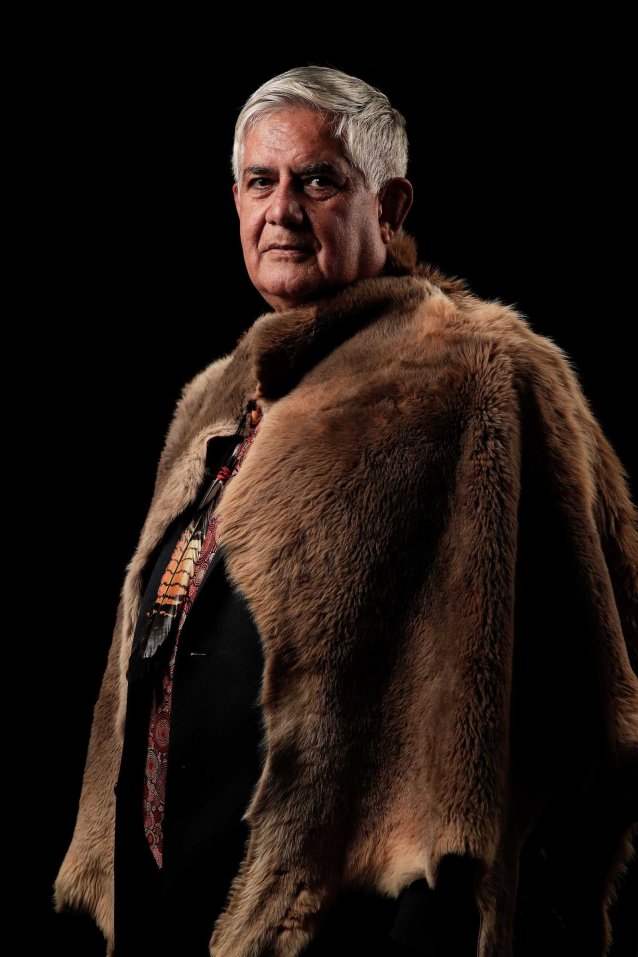
The photographic portrait of Ken Wyatt is from the NPG collection and it’s one of my absolute favourites. In 2010, Wyatt became the first Aboriginal or Torres Strait Islander person to be elected to the House of Representatives. He was also the first First Nations person to be made a government minister and the first to serve in cabinet.

The photo, taken by Alex Ellinghausen, is a sort of melange of news photography and classic portraiture. It was Wyatt’s first day in parliament, Alex saw Wyatt as he was walking through the press gallery wing of Parliament House, wearing a booka made of kangaroo skin and the feather of a red-tailed cockatoo, which symbolises leadership. It was given to him by the Noongar Elders from Western Australia. Alex grabbed him as he was walking past and asked him to do a quick portrait shoot, and this was the result. It’s beautifully lit and perfectly composed, and it captures Wyatt’s pride but also, I think, a hint of vulnerability or apprehension. It is an incredible portrait that resulted from serendipity, and the quick thinking of the portraitist, who saw an opportunity and took it.

A portrait is an exchange between the artist and the sitter, and then we, the viewer, bring our own consciousness to bear on it, and create meaning from it. The meaning we create is entirely up to ourselves. The people decide.

These portraits are important because they answer the question we ask of all our political leaders, whether or not we are lucky enough to be able to vote them in, or vote them out. It asks and answers the most basic of human questions – who are you? It is a joint search for truth.

And while a politician can attempt to massage that truth, they cannot ultimately control it once it’s taken. It is the property of everyone who sees it. And we are free to make whatever meaning from it we want.

That is what makes political portraiture more urgent and more important than ever, as global politics is roiled by the worst assaults on democracy we have seen in generations. Because portraits give us a glimpse of truth and allow us to make up our own minds about it. That is freedom, and it must always be protected.

© National Portrait Gallery 2026
King Edward Terrace, Parkes
Canberra, ACT 2600, Australia

Phone +61 2 6102 7000
ABN: 54 74 277 1196

The National Portrait Gallery acknowledges the Traditional Custodians of Country throughout Australia and recognises the continuing connection to lands, waters and communities. We pay our respect to Aboriginal and Torres Strait Islander cultures and to Elders past and present. We respectfully advise that this site includes works by, images of, names of, voices of and references to deceased people.

This website comprises and contains copyrighted materials and works. Copyright in all materials and/or works comprising or contained within this website remains with the National Portrait Gallery and other copyright owners as specified.

The National Portrait Gallery respects the artistic and intellectual property rights of others. The use of images of works of art reproduced on this website and all other content may be restricted under the Australian Copyright Act 1968 (Cth). Requests for a reproduction of a work of art or other content can be made through a Reproduction request. For further information please contact NPG Copyright.

The National Portrait Gallery is an Australian Government Agency