

Look
- Invite students to use drawing as a way of closely observing portraits.
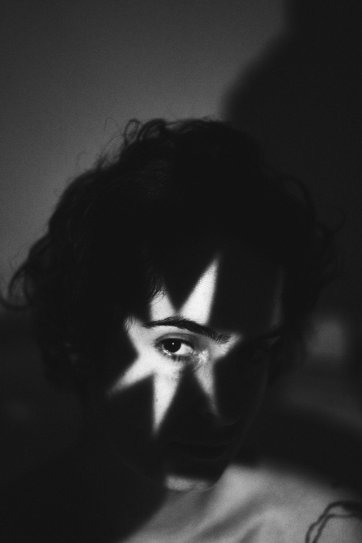
- Ask students to choose one portrait and use white pencil on black paper to block in the main areas of light and dark that they can see.
- Encourage them to focus on general shapes and lines rather than fine details. Remind students that this is about capturing the portrait’s light and dark values, not to create an exact copy.
Discuss
- Invite students to discuss their observations in small groups and view the three portraits side-by-side.
- Ask students to consider how the three artists have used light and shadow in the portrait.
Discussion prompts:
- What mood does the lighting create? What can you see that makes you say that?
- How do the light and shadows guide your eye through the portrait?
- What aspects of the composition are revealed by the light? What aspects are hidden in shadow?
- Do shadows conceal information or encourage us to imagine what might be hidden?
Connect
- Invite students to continue investigating one of the portraits through research.
- Ask students to consider how the use of light and shadow communicate the meaning behind the portrait.
- Encourage students to start by reading the artist’s statement before conducting broader research.
Inquiry prompts:
- How do you think the use of light and shadow emphasises the sitter’s story?
- How has the artist used light and shadow to communicate personal, social or cultural ideas?
- How does understanding the artist’s intentions change your interpretation of the portrait?
- What role does light and shadow play in the artist’s broader practice?
- How does light and shadow affect how someone is perceived?
Create
- Invite students to experiment with light and shadow to photograph a friend, family or community member.
- Ask students to take multiple photographs of the person and explore different techniques and effects.
- Encourage students to consider how light and shadow can communicate the subject’s identity and story and reflect on which approach achieved their intentions.
Creative prompts:
- Photograph the subject using five different lighting directions: front, side, back, above and below. How does the position of the light source in relation to the subject change the mood of the portrait?
- Project shadows onto the subject or use patterns and objects to cast shadows. What meaning do the shadows add to the portrait?
- Photograph the subject’s silhouette. What information about the subject can be hidden or revealed?