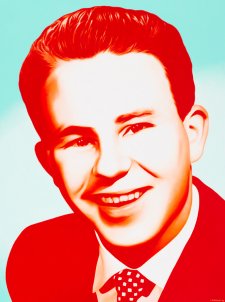
As keen as ever with a camera Ern McQuillan:
on assignment
Now in his late seventies, Ern McQuillan OAM is still taking
photographs. He started his career at 15 on Truth and
Sportsman newspapers and worked for the Women’s
Weekly, Sunday Telegraph, Daily Telegraph
and The Bulletin capturing decades of Australian sporting
identities and highlights. The son of famous boxing trainer Ern
McQuillan (senior), Ern also boxed professionally for two years,
sparring with world-rated fighters such as George Henry and Alex
Buxton. He abandoned the sport when his news editor demanded he
stop going on assignments with black eyes and split lips. From
his home in Sydney, he shares with Simon Elliott insights into
some of his key sporting images—images included in the exhibition
Depth of Field.
 |
|
The image of Lew Hoad playing
tennis to a capacity crowd in White City in 1955 is, for me,
one of your most outstanding images. It beautifully demonstrates
Hoad’s great athletic ability but you have managed to
capture something of the relationship between spectators and
sportsperson. Could you tell me what the photograph means
to you? |
Well, you know it is one of my favourite shots. The crowd at
White City Sydney was over 27,000 people and was so dominating.
I thought this has just got to make a picture, an action shot
of the Australian champion, Lew Hoad playing that backhand shot,
up on his toes with this massive crowd at the back. I was working
on the Daily Telegraph at the time and this picture just
stood out. I thought it was the showpiece of the whole tournament
and I can’t understand why the other papers didn’t
do the same at the time.
When Lew was at his top - especially in the 1955, 1956, 1957—in
my opinion he was unbeatable. He was a great tennis player, but
he had a lot of trouble with his back and I think that was the
cause of his early retirement. He was a great bloke to work with
too—so co-operative, he couldn’t do enough for you.
When Lew saw the picture, he took it back to Spain where he was
living and had it in his house.
 |
|
In the case of Lew Hoad you captured that
sporting moment. Such action shots of sportspeople are the
‘norm’ in sports photography but with your image
of Betty Cuthbert running you also managed to reveal something
of her great personal intensity. |
I hope so. Everyone thinks I took that photo at some important
racing event, but the truth is I took it down at her local park!
I went out to photograph Betty in 1955, prior to the Olympic Games.
She had won the NSW Championship 100 metres and practically everything
else. She was a very popular runner and a most co-operative girl.
She was living with her family at Ermington and her Dad had a
plant nursery there. I took pictures of her in the nursery, watering
the plants and doing bits and pieces. After we had finished doing
the pictures at the nursery I said ‘Betty, look would you
mind putting your running gear on and let’s get some good
action shots of you across the road in the park’. She said
‘No, not at all’. So, she put her gear on and we went
over the road and took three or four pictures of her running.
Simple as that! The park is gone now. It’s just a big industrial
area and as a matter of fact, the nursery is still there and is
called Cuthbert & Son P/L. Betty, as you know, won three gold
medals at Melbourne and then she won another gold medal at Tokyo
in 1960, so she won four gold medals during her career. It is
terrible to see how the poor girl is now with the illness she
has.
 |
|
There is also another interesting story
behind one of your most well known images- the iconic photograph
of champion jockey, George Moore. |
Yes, I took that picture in 1957 when George was riding Tulloch
(the great Australian race horse, probably the best horse since
Phar Lap in my opinion). I first met George in 1950 when he came
down from Queensland to Sydney and I have been friends with him
ever since. He was undoubtedly Australia’s greatest jockey.
He won ten Sydney Jockey Premierships. He rode over 2,000 races,
including 119 group one Australian races, a phenomenal record.
Do you remember the location of the shot?
It was taken at his home when he was living at Vaucluse, Sydney.
In those days there were no managers controlling the athletes
or the jockeys as there are now days. I went there especially
to take the picture and when I arrived he was playing tennis in
the backyard with some friends. I did some action pictures of
him playing tennis then I took pictures of him with his wife Iris,
and his children, and pictures of him looking at movies, races
- a complete series. Once that was done I said, ‘George,
look I have to get a shot of you with your jockey gear on.’
‘Okay mate, but do I have to put my britches on?’
He had a pair of nice white clean tennis shorts on at the time.
I said ‘no, leave them on’. So, there’s George
all dressed up in his jockey gear in a pair of tennis shorts which
I cut out of the image you see.
You were born in Sydney in 1926 and started
work as a cadet photographer at the tender age of 15. How did that
happen?
When I was very young I went to school at Newtown Technical Demonstration
School, and was very keen on playing football. Unfortunately in
my second year at Newtown I badly broke my leg playing the game.
On doctors orders I couldn’t play football for a whole year.
I said to my Dad that if I couldn’t play football next year
I didn’t want to go to school. I was 14. Dad said alright
and he got me a job. I went to work at Truth and Sportsman,
just prior to the Daily Mirror starting in Sydney, in
December 1941. I was made a copy boy in the photography department.
At the time the young men who were old enough were going into
the army. I would go out with the photographers on assignment
and carry their gear and help, and they showed me how to use the
cameras and so on. By the time I was 16, most of the young men
who were available working as photographers had gone into the
army, so they made me a cadet photographer. The first day I was
a cadet I was out on the road taking pictures which to my surprise
and delight were then published in the Daily Mirror the
very next day! It just carried on from there.
Given your father’s high profile as
a boxing trainer, you too tried your hand at boxing. Apparently
this had to stop because your editor couldn’t have you going
to take photographs with black eyes ….. is this true?
Yes, that’s right. The news editor was Len Richards. There
was quite a story behind all that. At the time I think I was 20
or 21. I was very fit as I had just got out of the army where
I had a lot of bouts. Anyway I was given a job to photograph the
wrestling at the Sydney Stadium on the Thursday night between
Chief Little Wolf and Dirty Dick Raines. It was the biggest wrestle
of the year (it was 1947), with very, very well known wrestlers
and over 15,000 people at the stadium. I arrived at the stadium
with the old press camera and camera bag over my shoulder. As
I walked down the ramp at the stadium, down towards the ring,
Harry M. Miller, who was the manager of the Sydney Stadium, said
‘Ernie, I’m glad you are here, you’ve gotta
fight.’ I said, ‘Fight, I can’t fight, I’m
here to photograph the wrestle’. ‘No’ he said,
‘we have a boy here by the name of Bill Squires, he is middle-weight,
the same weight as you, you will have to fight Squires’.
My father was there and he said ‘Yes, you’ve gotta
help out.’ It turned out that all the preliminary boxing
bouts prior to the wrestle had finished in one or two rounds and
so they had half an hour to fill in for the radio stations.
Well, the next thing I’m in the ring; my Dad is putting
the gloves on and sitting directly below me was Ezra Norton. He
owned the Daily Mirror and he was a very keen boxing
man. I was a copy boy there at 14–15 years of age, so he
knew me well. He was sitting with Eddy Ward, an old Labor politician,
and Mr Norton was pointing up to me talking to Mr Ward. I said
to my father, that I was here tonight to photograph the wrestling
and instead I’m boxing the main preliminary before the wrestle.
I was really worried about my photographic career. My father said,
‘I don’t know son, but you had better win.’
Anyhow I won in the second round which was pretty good given Bill
Squires’ own career.
Well, after the fight I ran up to the dressing room and spoke
to the Chief Little Wolf and told him what had happened. I said,
‘Now Chief, give me some pictures on the opposite side of
the ring away from Mr Norton’. So, you wouldn’t believe
it. In the very first round of the tournament they toppled out
of the ring right in front of me. They toppled out of the ring
and were wrestling amongst the crowd with spectators screaming
and cheering. I’m standing there with the old speed graphic
going bang, bang, bang and I got these great pictures of the two
wrestlers wrestling amongst the crowd! Obviously the Chief had
told Dick Raines that Ernie was in a bit of trouble and so created
a good scene for me to get some great pictures and good publicity
for the wrestlers and Sydney Stadium.
I went back to the darkroom that night. I had to go back because
the early country edition was 7 o’clock in the morning.
So I had to develop and print that night and leave them in the
sporting editor’s office. Of course, I thought that when
I went back in the morning I would probably get the sack. Mr Norton
was obviously going to say what’s the idea of McQuillan
boxing at Sydney Stadium when I had sent him there to photograph
the biggest wrestle of the year! Sure enough at 10 o’clock
the copy boy came from the editor. He had an envelope with my
name on it. I opened it up and it said ‘Congratulations
on the wrestling pictures from last night’, signed Len Richards,
news editor of the Daily Mirror. Mr Norton had obviously
said nothing whatsoever about the fight. So, I often wonder if
I had gotten beaten I would have probably got the sack. That was
about the finish of my boxing career then.
 |
|
 |
|
|
You were awarded an OAM for services to
journalism particularly in the field of media photography.
Can you give me a brief overview of the years in between to
the present? |
Well I have always really enjoyed both sport and photography
and yes I am still out doing work. I joined Consolidated Press
in 1948 and 1951 I was fortunate enough to win first and second
prizes in the inaugural Australian press photographers exhibition.
There were hundreds of entries from newspapers all over Australia.
I won Best News Picture Award with “Weather Woes”
and the Most Highly Commended Award with “Along the Pumice
Trail”. “Along the Pumice Trail” was taken in
early 1951 after the Mount Lamington volcanic explosion which
killed thousands of Papua New Guineans.
I left Consolidated Press in 1958 to do freelance and commercial
photography. In 1967 I went to Vietnam as a freelance photographer
but only spent three months there. After almost 20 years doing
freelance and commercial photography, I rejoined the photographic
staff of Consolidated Press in 1977 and worked for the Women’s
Weekly, and The Bulletin with Bob Carr (now Premier
of NSW), when he was a young journalist. We did many political
assignments and general news stories together. In 1988 I retired
from Consolidated Press and now take things a lot quieter. It
was a great moment when I was awarded that OAM in 1998 and I am
still as keen as I ever was with a camera. As a matter of fact,
I am going out to a job this morning for the Australian Jockey
Club so I had better finish up as I will be leaving here in the
next 10 minutes!
Interview with photographer Ern McQuillan by Simon Elliott May
2004
|