Artist Statement

There are so many stories to tell and so many places to begin, but on this occasion I have no where else I can start but in British Museum - the events taking place here having happened some time in my own past, though they have since remained ever present.

 It is through hindsight that I come to believe that it was in this museum that I discovered the subject and focus of my life's obsession. Wandering through the exhibition halls and corridors I began to realise that by moving from object to object, steadily taking in a little of what each had to tell me, I was actually awakening memories that reached beyond my usual scope. I felt my boundaries expanding; I became momentarily terrified of the infinite; I felt both enormous and minute. I had an overwhelming desire to create edges for something that I now know had none.

This was an experience of becoming part of the memories that have been contained within the objects on display - I believe I was able to experience my own narrative smeared across history itself as I navigated my way through the collections - interpreting found narratives as I went. It became clear that my own self - my own memories, my own personal narratives, were not clearly defined within myself, and indeed extended way outside of the limits of my own body.

It was at this point that thoughts of the cube first entered my mind. This moment saw the genesis for the initial concept of a device for collating, cataloguing and storing my life's memories within a single, instantly perceivable unit.

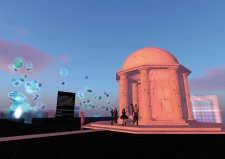
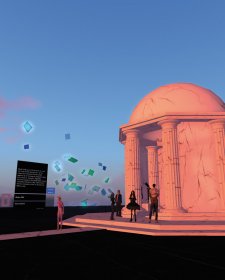
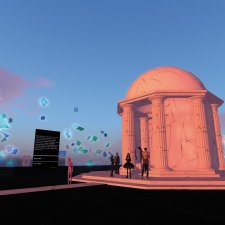
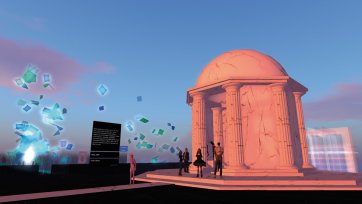
The cube device is a large structure: Unsupported, floating in a void. Because it exists in isolation, signifiers of scale do not exist; to ask how big it is becomes irrelevant and we must, therefore, rely upon our imagination to give this object a dimension – it is ironic that the virtual allows us to supplement our imagination with this temporary model. To fully visualise this structure, it is necessary to form a mental image of a simple line drawing of a cube, then create another one hundred and twenty four of these and stack them together to form a larger cube, five cubes, by five cubes, by five cubes. Allow the cubes to move slightly apart from each other and form a matrix of 125 interconnected nodes, able to pass a simple message between them, as a navigable route is found through the paths that their connections form.

Consider that these nodes exist on a three dimensional axis: x, y and z. Labels can be placed on each of the axes as follows:


Along the X-axis.

  1. Items bearing direct relation to my own personal history.
  2. Items of organic origin, preserved or otherwise.
  3. Items whose alleged history I cannot validate.
  4. Items whose existence has been kept a secret.
  5. Items susceptible to shift category without notice.


Along the Y-Axis.

  1. Items whose significance is known only to myself.
  2. Items relating to history of those around me.
  3. Items of no apparent relevance to myself.
  4. Items of no physical substance.
  5. Items I only know of through hearsay.


Finally the Z-Axis.

It follows the structure of the x and y-axes through five layers loosely related to major time periods of my life; the boundaries between these divisions are the hardest to define, and the cusps are almost impossible to pinpoint. Nominally, they run as follows.

  1. Imagined past.
  2. Recent past.
  3. Present.
  4. Close Future.
  5. Imagined Future.


This, then, is the structure I have planned ever since my visit to the museum that day. One hundred and twenty five interconnecting sites in space, each node connected to three, four, five or six other sites, depending on its position within the framework. 

While this structure remained a purely a mnemonic device within my imagination, things remained to a certain extent under control. But I suppose I have always knows that I have created more than just a way of recalling objects and relationships between objects, and that the shift from imagination to reality will indeed bring about the ultimate redistribution of my own narrative across space and time, the final and inevitable moment that will come approximately two years from now - but started out as a simple thought in the museum all those years ago...

Click here to view the image credits.


Contributing Artists Gazira BabeliArtistname LastnameCao FeiArtistname LastnameAdam Nash, Christopher Dodds, Justin Clemens