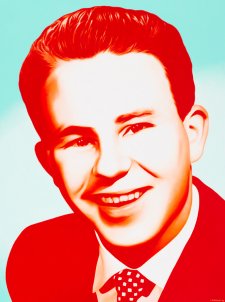





Sir Edward Holden 1945 Promise fulfilled Early February 2006 saw the gift to the National Portrait Gallery of a bust of Sir Edward Holden, industrialist and politician, from the estate of Sir Edward’s son, John Holden. At a small function attended by members of Edward Holden’s family, including several of his grandchildren, Mr Andrew Buttfield presented the bust to Board Chair Marilyn Darling, warmly relating the impressions he retained of his grandfather from his own boyhood in Adelaide. Sir Edward Wheewall Holden (1885-1947), industrialist and politician, was the son of Henry Holden, industrialist and civic leader, and the grandson of James Alexander Holden, Adelaide leather and saddlery business owner. The family firm expanded after winning large saddlery contracts during the Boer War, and after 1909 it branched into motor-body trimming, making hoods, bodies, and motor cycle sidecars. Edward Holden started work at Holden and Frost Ltd after graduating with a BSc from the University of Adelaide. His prototype for a standard body for imported chassis, made in collaboration with Dodge distributor SA Cheney, led to the formation of Holden’s Motor Body Builders Ltd in 1917, with Edward as Managing Director. Producing bodies for the American-owned General Motors from 1923, by that year Holden’s was accounting for half the national output of car shells. Edward Holden oversaw the expansion to a large plant at Woodville (the largest outside North America) incorporating the latest technology including automated production lines. By 1929, with 3400 workers, Holden’s was the biggest body-builder in the Empire, but late in the year General Motors revised its orders, which had represented about 60% of Holden’s output. With the firm struggling to survive, the following year Edward Holden set out for the USA to discuss amalgamation with GM. In 1931 GM bought the company, taking complete control while maintaining its Australian character. Holden became chairman of General Motors-Holden’s Ltd. He was its sole managing director until the arrival of Englishman Sir Laurence Hartnett from GM subsidiary Vauxhall Motors in 1934. Holden turned to other affairs before resigning from GMH in early 1947. As a Liberal in the Legislative Council from 1935 to 1947 Holden strongly supported initiatives to attract industry to South Australia. Honorary controller of army canteens in 1939-1945, he was knighted in 1945. After the war he continued with many and various directorships and corporate service with bodies including the South Australian Industries Assistance Corporation, the Chamber of Commerce, the Bank of Adelaide and Australian Cotton Textile Industries. Holden’s energetic contribution to public life was perpetuated by his daughter Nancy (later Dame Nancy Buttfield), the first South Australian woman in an Australian parliament, whose portrait in the NPG collection was highlighted in Portrait 18. Leslie Bowles (1885-1954), who made this bust the year Holden’s knighthood was conferred, was born in Sydney and began his studies in modelling and woodcarving at the Brisbane Technical College. In 1910 he won a McConnell scholarship and travelled to London, where he studied at the South London School of Sculpture and the Royal Academy School and served as an assistant to Bertram MacKennal. After serving in the Royal Tank Corps in France from 1914 to 1919, Bowles resumed his studies at the Royal Academy before returning to Australia in 1924. Alongside a number of other artists, from the mid 1920s onward Bowles was employed by the Australian War Memorial on the production of dioramas depicting aspects of the First World War. From 1925 to 1931 he was head sculptor of the modelling section at the Memorial. His diverse work included several major sculptures, including The man with the donkey; the gargoyles in the commemorative courtyard; and, with Napier Waller, the initial sculptural feature for the Hall of Memory. In 1931 he established a studio in Melbourne, where one of his best-known works, Diana and the Hounds (1939-40), stands before the Spanish-style conservatory in the Fitzroy Gardens. Bowles was a prominent advocate of sculpture and was often consulted on the commissioning of sculptures and memorials until his death in 1954. Accepting the bust of Holden, Marilyn Darling recalled that it was the first work promised for the collection when she and Gordon Darling began to promulgate their ideas for a National Portrait Gallery in the early 1990s. Now in its permanent home, the bust thus commemorates not just one Australian of energy and enterprise, but several, at the same time as it testifies to a life of exceptional public service and a family’s affection and respect. Sarah Engledow References
Jo Buttfield, Alan Symons, Rachel Symons, Andrew Buttfield, Anne Symons, Kirsty Buttfield, Joan Lyons, Edward Lyons, Didy McLaurin, Susie Lyons - at the handover of the Sir Edward Holden bust, February 2006.
|