Best of British logo

12

Sir Richard Branson Sir Michael Caine Sir Paul McCartney Salman Rushdie Helen Mirren
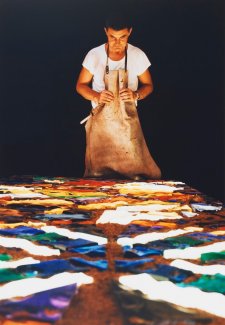
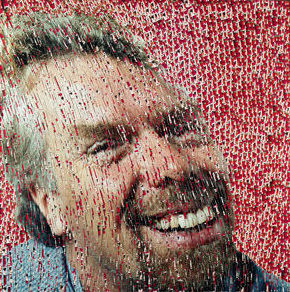
Sir Richard Branson
by David Mach
Sir Michael Caine
by James Hague
Sir Paul McCartney
by Humphrey Ocean
Salman Rushdie
by Bhupen Khakhar
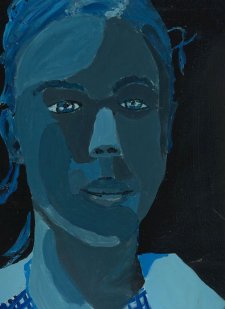
Helen Mirren
by Ishbel Myerscough

For the first hundred years or so of its existence, The National Portrait Gallery in London had no contemporary collection at all. Founded by act of parliament in 1856, the Gallery had a brief to collect the likenesses of famous British historical figures. In trying to find a way to acknowledge lasting eminence, but exclude ephemeral celebrity, the trustees decided that with the sole exception of the reigning sovereign, subjects included not only had to be dead, but dead for ten years.

Inevitably this meant that opportunities to acquire significant works were lost and worthy sitters went unrecorded by any artist. Such was the case until 1968 when the rules were relaxed to allow living sitters to be included. Soon the portraits of many distinguished living subjects entered the collection - sculptor Henry Moore and author E. M. Forster were the first - but in reality few contemporary works of art were acquired. It was not until 1980 that the Gallery began to entertain the idea of commissioning portraits specifically for the collection, but since then the Trustees have commissioned 112 paintings, drawings and sculptures.

The new policy not only enlivened the display, but provided an opportunity to redress some of the imbalances in the existing collection; whereas artists, writers and musicians were well represented, there were few portraits of scientists, or sporting and business people. Portraits of women were also greatly outnumbered by portraits of men. Maggi Hambling's portrait of the crystallographer Dorothy Hodgkin was one of a number of works which helped to fill the gap. The repeated use by curators, publishers and teachers of this extraordinary image of the scientist at work - so active that to the artist's eye she requires an extra pair of hands to cope - is perhaps the most eloquent testament to the need which it met.

Twenty-four of the works in the present display were directly commissioned by the Gallery, many as a result of the annual 'Portrait Award'. This competition, inaugurated in 1980 and now sponsored by BP, encouraged young artists to focus on a genre felt to be in terminal decline. It offered both a cash prize and the opportunity for the winner to paint a well-known figure for the Gallery's collection. The competition has gained in prestige from modest beginnings to an annual entry of about 700 works and, this year, over 170,000 visitors. Eleven of the winners' commissioned portraits are included here, many marking the start of highly successful careers. To take just one example, Tai Shan Schierenberg, a winner in 1989, was invited to paint Sir John Mortimer. The distinguished barrister and playwright duly appeared in a flamboyant, confident portrait, seated in rather ironic dignity in the artist's studio. From this work have flowed a succession of solo shows in a commercial gallery, a commission to paint the Queen and a further commission from the National Portrait Gallery.

While the Portrait Award achieved its aim of persuading young artists to look to portraiture as a worthwhile artform and engaged the interest of the wider public, it would be disingenuous to ignore the influence not only of three great British figurative artists, Francis Bacon, Lucian Freud and David Hockney, but of the wider practice of figuration of which the 'School of London' in general is representative. Though the National Portrait Gallery has as yet no Francis Bacon and no major painting by David Hockney, we are fortunate to have on loan the portrait of Lord Rothschild by Lucian Freud. Fortunate too, in that a number of artists not necessarily associated with portraiture have produced works of great distinction for the collection. Among these are the portrait of Doris Lessing by the Royal Academician, Leonard McComb, the luminous portrait of Dame Iris Murdoch by Tom Phillips, the witty collage of Sir Richard Branson by David Mach and perhaps most touchingly, the portrait of the author A. S. Byatt by the great colourist and abstract artist Patrick Heron. Painted at the very end of the artist's life, it takes representational portraiture to the border of abstraction, producing, as the sitter has written, 'a vanishing, watching body in a sea of light and brilliance'.

All these portraits are normally part of a permanent display in London. They hang together with numerous other works in a loosely thematic arrangement, accompanied by displays of sculpture and photographs attempting to give a flavour of contemporary British life and portraiture. Seen here in a different continent, in a different light and in a new context, divorced from the wider story which they usually tell, they still seem to suggest that the painted, drawn and collaged image has something to offer in the electronic age.

Honor Clerk
Curator, Twentieth Century Collection

National Portrait Gallery, London


Visit www.npg.org.uk for more.

12